


If you bought a car in the last five or six years, there is a good chance it does more than just drive. It nudges the steering when you drift out of your lane on the PIE. It slows down when the car ahead brakes hard. It beeps when someone slips into your blind spot.
All of that comes from a group of systems known as ADAS, and most drivers never think about them until something stops working. Here is the part that surprises people: these systems can be knocked out of accuracy by things that feel unrelated, like a new windscreen, a bumper repair, or a change in how the car sits on its suspension. Putting them back to the aim the manufacturer intended is called ADAS calibration, and not every workshop is set up to do it.
What ADAS Means in Plain Language
ADAS stands for Advanced Driver Assistance Systems. It covers the safety features that watch the road and either warn you or take a small action on your behalf. Depending on your make and model, you may have some of these:
- Autonomous Emergency Braking (AEB). Senses a likely collision ahead and brakes if you do not react in time.
- Adaptive Cruise Control (ACC). Holds a set gap from the vehicle in front instead of a fixed speed.
- Lane Departure Warning and Lane Keeping Assist. Reads the lane markings, then alerts you or gently steers back if you wander.
- Blind Spot Monitoring. Usually radar based and mounted near the rear bumper, it flags vehicles your mirrors cannot see.
- Rear Cross Traffic Alert. Warns you about vehicles crossing behind while you reverse out of a parking lot.
- Traffic Sign Recognition. A forward camera reads speed limit signs and shows them on your dashboard.
- 360 degree and reversing cameras. Several cameras stitched together for a bird’s eye view when parking.
These are not gimmicks. Research by the Insurance Institute for Highway Safety found that vehicles with automatic emergency braking had around 50 percent fewer police reported rear end crashes, and 56 percent fewer such crashes causing injuries, than the same models without it. That is a real safety benefit, but only while the system is aimed correctly.
What ADAS Calibration Actually Is
Every camera and radar has a fixed idea of where “straight ahead” and “level” are, set at the factory. The camera behind the windscreen knows how high it sits, at what angle it tilts, and how its view lines up with the centre of the car. The radar in the grille knows the same thing.
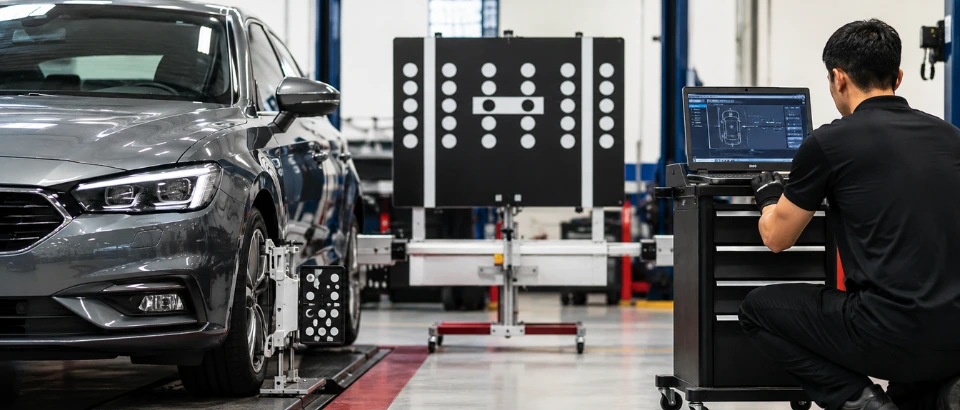
Calibration re-establishes that reference after something disturbs it. A technician follows the manufacturer’s steps, places targets at measured distances and heights around the vehicle, connects a diagnostic tool, and tells the system to re-learn its aim.
This has to be precise because of simple geometry. A sensor off by one degree does not stay one degree off, because the error grows with distance. At 100 metres, one degree of misaim shifts the aiming point sideways by roughly 1.7 metres, which is more than a full lane width. A radar that thinks it is watching the car in your lane could be tracking the car in the next lane, or missing it completely.
Static and Dynamic Calibration
There are two broad approaches, and many vehicles need both.
Static calibration happens indoors with the car stationary. Targets are placed around the vehicle at exact distances set by the manufacturer. This needs a level floor, controlled lighting, clear space, and the correct target set for that brand. A sloped ramp, a bright window reflecting onto a target, or a wall too close behind can cause a failed or false result.
Dynamic calibration happens on the road. The technician connects a diagnostic tool and drives at a steady speed on a stretch with clear lane markings so the system learns from real traffic. Some brands ask for a set speed range held over a certain distance, which in Singapore is harder than it sounds because congestion makes a constant speed difficult to hold.
Which method applies is decided by the vehicle manufacturer, not by the workshop’s preference.
Situations That May Call For ADAS Calibration
Requirements vary widely between brands. These are the common situations where you should ask the question rather than assume.
- Windscreen replacement or refit. The forward camera usually sits behind the glass. A small change in how the bracket or glass sits changes what the camera sees. Thatcham Research, a UK vehicle safety and repair organisation, led an industry code of practice specifically for recalibration during windscreen replacement, because system performance can suffer without a proper process.
- Collision or accident repair. Bumper covers, grilles, tailgates and mirror housings often hold sensors. Removing and refitting those panels can shift a sensor by a few millimetres, which is enough to matter.
- Sensor or camera replacement. A new part arrives with no memory of your car and has to be taught its position.
- Suspension work or ride height changes. Springs, shock absorbers, coilovers and anything that changes how high the car sits also change the angle at which the camera and radar look at the road.
- Wheel alignment, especially rear adjustments. I-CAR, a collision repair training organisation, notes that a number of vehicle makers require calibration when a wheel alignment is performed, and some require the car to sit on the alignment rack during the calibration itself.
- Steering angle sensor work. This sensor reports which way the front wheels point, and several features depend on it agreeing with what the camera sees.
Why Wheel Alignment Sits So Close To This Topic
Your car does not always travel in the direction the front wheels point. The rear axle sets the actual direction of travel, and the angle between that direction and the car’s centreline is called the thrust angle. If it is off, the car quietly crabs down the road even though the steering wheel looks straight.
Now picture a forward radar calibrated to the centreline. If the body travels at a slight angle to it, the sensor is aimed off the car’s real path. That is why geometry has to be correct before a calibration, not after.
It works the other way too. A workshop doing wheel alignment and tyre balancing on an ADAS car should know that adjusting toe, particularly at the rear, may create a calibration requirement for that model. Our explanation of caster, camber and toe covers what each angle actually controls.
Warning Signs Worth Paying Attention To
Modern systems often fail quietly and do not always throw a dashboard light. Keep an eye out for:
- A message saying a system is unavailable, especially soon after a repair.
- Lane keeping that tugs the steering when you are clearly centred in your lane.
- Adaptive cruise control that brakes for nothing, or ignores a car slowing ahead.
- Blind spot alerts that fire on empty lanes, or stay silent when a vehicle is beside you.
- Emergency braking that triggers on a road sign, a lorry in the next lane, or an overhead gantry.
- Reversing guidelines that no longer match where the car actually goes.
If a system feels unreliable, do not switch it off and carry on. That removes a safety layer you paid for. Get it checked and get the fault written down.
Why This Is Not Ordinary Mechanical Work
A good mechanic can be excellent at brakes, suspension and engines and still not be equipped for ADAS calibration. The job needs:
- Space and a flat floor. Some procedures need several metres of clear, level ground around the car. Many workshops do not have that bay free.
- Brand specific targets. Targets are not generic posters. Each manufacturer specifies its own patterns and mounting distances.
- Current procedures. These change with model years and software updates. An outdated procedure gives a confident looking result that is wrong.
- A diagnostic tool with the right coverage. It has to talk to that exact control module and finish the routine.
- Trained technicians. Someone has to spot a failed calibration that reports as a pass, and know when to escalate.
- A proper job ends with a report showing the calibration passed. Keep it with your service records.
Preparation counts too. Correct tyre pressures, the specified load condition, an empty boot and a clean windscreen are part of the procedure for many brands.
What Can Go Wrong When Calibration Is Skipped
The uncomfortable truth about a badly calibrated system is that it usually still works. It just works wrongly. A radar aimed slightly high may miss a stationary vehicle it should have seen. A camera aimed slightly left may read the wrong lane line and steer you toward the kerb. A driver used to the car catching mistakes may also react more slowly when it does not. And if a repair affected a safety system that was never restored to specification, that can complicate an insurance claim later.
What Singapore Drivers Should Know
A few local points are worth keeping in mind.
Vehicles here must meet recognised international standards. The Land Transport Authority states that all vehicles registered in Singapore must comply with technical standards, and that fitted vehicle technologies must meet internationally recognised safety standards such as those adopted in the EU, Japan and the USA.
Tyre and rim sizing is not a styling choice. LTA guidance says every wheel should carry a tyre of the width, profile and diameter recommended by the vehicle manufacturer, and that the overall rolling radius should stay the same as the original. Rolling radius also affects wheel speed signals and ride height, both of which feed into how assistance systems judge speed and distance. Good reason to stay with the manufacturer’s specification when replacing your tyres.
Windscreen tint has limits. At least 70 percent of light must pass through the front windscreen, and film applied near a camera housing can interfere with what the camera sees. Check before you tint.
Suspension changes have conditions. LTA guidance says aftermarket suspension should not adversely affect steering and manoeuvring, and that modifications must be installed by qualified personnel according to manufacturer recommendations. It also points drivers to the General Insurance Association of Singapore’s advice to tell your motor insurer about modifications, since failing to do so can affect claims.
Questions To Ask Before You Book
These questions sort out capability quickly:
- Does my make, model and year require calibration for the work being done?
- Is it static, dynamic or both, and can you perform it here?
- Which procedure are you following, and is it current for my model year?
- Will I get a report confirming the calibration passed?
- If it cannot be completed, what will you tell me before I drive away?
That last one matters most. A trustworthy workshop will say plainly that a system cannot be relied on, rather than handing the car back and saying nothing.
Where Swift Tyre Specialist Fits In
We are a tyre and general workshop, not an ADAS calibration centre, and we would rather say so clearly. If your car needs calibration, your manufacturer’s agent or a dedicated calibration facility is the right place for that job.
What we can do is the groundwork underneath it. Correct tyre sizing, balanced wheels and accurate geometry all affect how your car tracks down the road. Our workshop uses a Hunter Hawkeye computerised alignment system, and we road test the car and hand you a printed alignment report before we call the job done. Keep that printout, because a calibration technician will want to see that your geometry is already within specification.
We also handle the everyday things that keep a car predictable: tyre repairs, tyre replacement and general work at our car repair workshop. Not sure your assistance systems are behaving normally? Start with a professional tyre inspection and an alignment check, then take the calibration question to your manufacturer’s network. Call us at +65 8484 3838 to get that booked.
Frequently Asked Questions
Q: Does every car need ADAS calibration?
A: No. Only vehicles fitted with cameras or radar that support driver assistance features. If your car has no lane keeping, adaptive cruise, blind spot monitoring or emergency braking, there is nothing to calibrate. Your owner’s manual lists what is fitted.
Q: How long does it take?
A: It varies by brand and by how many sensors are involved. A single forward camera is usually quicker than a job needing several static setups plus a road drive. Ask for an estimate when you book, and expect dynamic procedures to run longer in traffic.
Q: Can I just clear the warning light instead?
A: Clearing a code does not re-aim a sensor. The light may come back, or stay off while the system keeps looking in the wrong direction. That is the worst outcome, because you get no warning that something is wrong.
Q: Do I need calibration after a normal wheel alignment?
A: It depends on your make and model. Some manufacturers require it, particularly after rear toe adjustment, and some do not. Ask your workshop to note exactly what was adjusted, then check the requirement for your vehicle.
Q: Will bigger rims affect my ADAS?
A: They can. Changing rolling radius or ride height alters how the car reports speed and how sensors sit relative to the road. LTA guidance also requires rolling radius to stay the same as the original, so the manufacturer’s specification is the safe path.
Q: Is ADAS calibration a legal requirement in Singapore?
A: There is no separate calibration inspection for private cars. The obligation is to keep your vehicle compliant with the standards it was approved under and to follow your manufacturer’s repair procedures. Treat it as a safety and warranty matter, not a licensing one.