


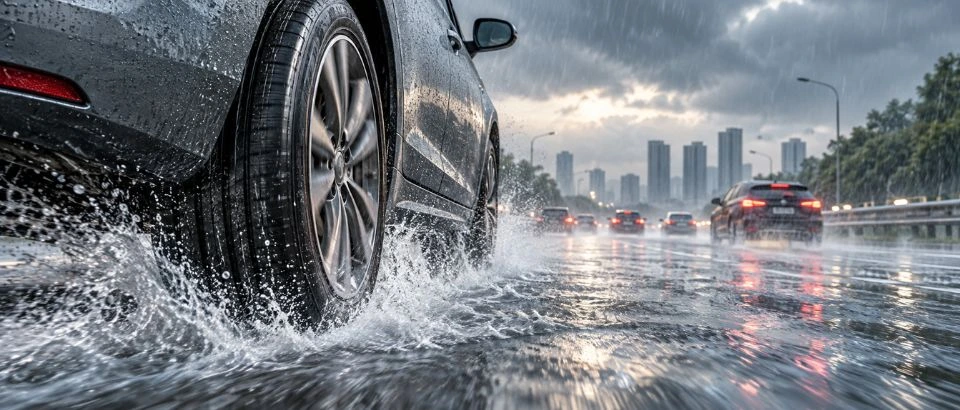
Most drivers here have had the moment. You are on the expressway during a downpour, you hit a patch of standing water, and for a second the car goes quiet and light. The steering stops feeling connected to anything. Then it comes back, and you carry on with your heart going.
That is aquaplaning. It is not bad luck and it is not usually bad driving. In almost every case it comes down to how much tread was left on the tyres and how fast the car was going.
The Meteorological Service Singapore splits our year into two monsoon seasons with inter-monsoon periods between them, and the wet phase of the Northeast Monsoon runs from December into January, when monsoon surges bring widespread moderate to heavy rain. Which makes now a sensible time to look at your tyres, before the heaviest weeks arrive.
What Aquaplaning Actually Is
A tyre does not grip wet road by pressing through the water. It grips by getting the water out of the way first.
The grooves in your tread are drainage channels. As the tyre rolls, water is forced into them and pushed out to the sides and behind the contact patch. What is left is a thin film, and the rubber works through it to reach the road.
That only works up to a point. Continental describes what happens next: the less tread you have remaining, the more likely a wedge of water builds up ahead of the tyre, and the tyre loses contact with the road. Once that happens, the tyres can no longer transmit steering commands or braking forces, and the car drifts out of control.
This is a capacity problem. Your tyre can only move so much water per second. Push past that figure, by driving faster, hitting deeper water, or having less tread to work with, and the water wins. It also explains why aquaplaning feels so strange. The car is not skidding the way it slides on a loose surface. It is briefly floating, with no useful connection to the road. Turning the wheel does nothing. Braking does nothing. The car carries on in the direction it was already going.
Why Tread Depth Decides Nearly Everything
This is where the discussion usually gets vague, so here are real numbers.
Continental published results from a test by the German magazine AutoBild, run on a VW Golf fitted with 225/45 R17 tyres at different tread depths, braking with ABS on a wet surface.
Braking from 80 km/h:
- Brand new tyres: stopped in 25.8 metres
- 3mm of tread remaining: 31.0 metres
- 1.6mm of tread remaining: 36.2 metres
Braking from 120 km/h:
- Brand new tyres: 59.1 metres
- 3mm of tread remaining: 124 metres
- 1.6mm of tread remaining: 154.9 metres
Look at the 120 km/h figures again. At 3mm the stopping distance more than doubled against new tyres. At 1.6mm it was roughly two and a half times longer. That is the difference between stopping behind the car in front and arriving in its boot.
Continental’s own conclusion is worth repeating: running tyres down to 3mm is acceptable, but at the legal minimum of 1.6mm, things get dangerous.
Legal Minimum is a Floor, Not a Target
In Singapore the legal minimum tread depth is 1.6mm. Bridgestone Singapore notes that LTA legally requires tyres to be replaced at that point, and that the tread wear indicator bars moulded into the main grooves sit at exactly that depth.
Here is the part worth sitting with. 1.6mm is where the tyre becomes illegal. It is not where it becomes unsafe. Based on the braking figures above, wet performance has already fallen off badly well before you get there.
Think of it like a fuel gauge. The light coming on does not mean you have the right amount of fuel. It means you are nearly out.
Since heavy rain here is a regular part of the year rather than a seasonal event, planning to replace at around 3mm is a sensible approach. You lose a little tyre life. You gain a lot of wet braking.
Depth is Not the Only Thing That Matters
Tread depth is the biggest single factor, but three others change your risk and all are within your control.
- Tyre pressure. An underinflated tyre flexes and the centre of the tread lifts slightly off the road, so the contact patch cups inwards. Water collects in that dip instead of being pushed out. Continental lists routine pressure checks on all four tyres as one of its main recommendations for reducing aquaplaning risk. Check monthly when the tyres are cold, using the recommended tyre pressure for your car.
- Uneven wear. Tread depth is not one number. A tyre can have healthy depth across most of its width and a worn band on one shoulder, usually from alignment being out. That worn strip is where water gets through first. If you have noticed a pull to one side or an off-centre steering wheel, wheel alignment and balancing is worth doing before the wet season, not after it has eaten a tyre.
- Age and hardening. Rubber stiffens over the years, and a hardened compound grips wet road less well even when the tread looks fine. Constant heat and UV speed that up here. A tyre with decent tread that is eight or nine years old is not the tyre it was when new, which is why tyre age can matter as much as tread depth.
The tyre itself matters too. Wet performance depends on tread pattern and compound, not just depth, which is why two tyres at identical depth can behave quite differently in standing water. If you are choosing replacements, wet grip is worth more to a driver here than almost anything else on the label. We have gone through the top car tyre brands in Singapore separately.
Checking Your Own Tread in Two Minutes
You do not need tools for a rough check, though a depth gauge costs little and gives you a real number.
- Find the wear indicator bars. Look into the main grooves and you will see small raised blocks of rubber running across them. When the tread surface is level with those bars, you are at 1.6mm and the tyre is finished.
- Check in several places. Measure the inner edge, centre and outer edge of each tyre, at two or three points around the circumference. A single reading tells you little. The differences between those points reveal an alignment or pressure problem.
- Check all four, plus the spare. Rear tyres on a front wheel drive car often wear far more slowly, so one axle can be fine while the other is nearly gone. Regular tyre rotation helps keep that wear even.
- Look at the sidewalls too. Cuts, bulges or cracking matter regardless of tread depth.
For the full version, our post on what happens during a professional tyre inspection walks through what a workshop checks beyond this.
What It Feels Like Just Before It Happens
Aquaplaning gives you a second or two of warning if you know what to feel for.
- The steering goes light. The clearest sign. The usual weight and feedback through the wheel suddenly disappears.
- The engine note rises slightly without you pressing the accelerator, because the wheels are spinning a little faster with nothing holding them back.
- Road noise changes. Tyre roar drops away or turns into a splashing, rushing sound.
- The car drifts even though you have not turned the wheel.
- The traction control light flickers.
If you are in heavy rain and the steering goes light, that is the moment to respond, not after the car has already moved.
What to Do When the Car Starts to Float
Everything your instincts tell you to do here is wrong. Braking and steering are exactly what you must not do, because the tyres have no grip to act on, and whatever input you make lands suddenly and violently the moment grip returns.
The AA sets out the response clearly:
- Do not slam the brakes.
- Ease off the accelerator gently. Not a sudden lift, just a steady reduction.
- Hold the steering wheel straight and steady. Keep the car pointed where it is already going.
- Relax your grip but stay in control, and wait for the feeling of road contact to return.
- Once you feel grip come back, brake gently to bring your speed down.
Two things that matter in practice. If cruise control is on, switch it off, since the system may try to hold speed through the water. And in a manual, dipping the clutch helps the car settle.
The whole event usually lasts a second or two. Doing nothing dramatic is the correct answer, which is why thinking about it in advance helps. Most people’s natural reaction is to stamp and steer, and that is what turns a scare into a crash.
Driving Through a Downpour Here
Local rain has its own character. It arrives fast, it is heavy, and it often stops as quickly as it started.
- Slow down early. Aquaplaning risk rises steeply with speed. Dropping from 90 to 70 on a flooded expressway section changes your odds more than anything else you can do at that moment.
- Leave much more space. The braking figures above come from a controlled test. On a real road with worn tyres and standing water, your stopping distance is far longer than the gap you normally keep.
- Follow the tracks of the car ahead where it is safe. Those wheel paths have already had water pushed out of them.
- Avoid lane changes in standing water. Crossing a ridge of water at an angle is a common way to unsettle a car.
- Watch the outer lanes and kerbside. Water collects where the road camber drains, so the left lane and shoulder often hold the deepest water.
- Be careful in the first few minutes. Oil and rubber lift off the road surface when rain first falls, and grip is at its worst before the rain washes it clean.
- Headlights on, demister on. Visibility and grip are separate problems and heavy rain gives you both at once.
- After deep water, test your brakes gently when it is safe. Wet discs take a moment to bite.
When to Replace Rather Than Wait
Replace when any of these apply:
- Tread is at or near the wear indicator bars anywhere on the tyre.
- Tread is below roughly 3mm with the wet season coming.
- There is a bulge, deep cut or exposed cord in the sidewall. These are not repairable.
- The tyre is approaching ten years from its date of manufacture, stamped on the sidewall as a four digit code (week and year). Our guide to what the numbers on your tyre mean shows where to find it.
- One tyre is far more worn than its pair on the same axle. See whether you need to replace all four tyres at once.
Where tread is uneven rather than uniformly low, replacing without fixing the cause just means the new tyre wears the same way. Alignment comes first.
Getting Your Tyres Checked Before the Monsoon
At Swift Tyre Specialist we measure tread across each tyre rather than eyeballing one groove, check pressures, and tell you where you stand. Sometimes the answer is that you have another six months of use, and we would rather say that than sell you tyres you do not need yet.
If a tyre is repairable we will repair it. Our car tyre repair service covers punctures in the central tread area, though sidewall and shoulder damage cannot be safely repaired on any tyre. Where replacement is the right call, we will talk through wet grip options rather than quote the cheapest fit.
Come to our car repair workshop at Kaki Bukit, or call +65 8484 3838. We also do onsite tyre replacement across Singapore if you are stuck somewhere in the rain.
Frequently Asked Questions
Q: At what speed does aquaplaning start?
A: There is no fixed number. It depends on water depth, your remaining tread, tyre width and the weight of the car. Worn tyres start aquaplaning at meaningfully lower speeds than new ones, which is why reducing speed in heavy rain is the most effective single thing you can do.
Q: Is 1.6mm of tread safe for Singapore roads?
A: It is legal, not safe. Continental’s test showed wet braking from 120 km/h taking 154.9 metres at 1.6mm against 59.1 metres on new tyres. Given how much rain we get, replacing at around 3mm is more sensible.
Q: Does aquaplaning damage my car?
A: The aquaplaning itself usually does not. Damage comes from the reaction, whether that is a collision or a hard input landing the instant grip returns. If you hit a deep pothole hidden under standing water, have the suspension and alignment checked afterwards.
Q: Do wider tyres aquaplane more easily?
A: Generally yes, all else equal, because the weight is spread over a larger area and there is more water to clear per unit of load. Tread pattern and compound still matter a great deal, so a well designed wide tyre can beat a poor narrow one. More on wide vs narrow tyres and safety.
Q: Can I rely on traction control or ABS to save me?
A: No. Both systems work by managing grip at the tyre. When the tyre is riding on water there is no grip for them to manage. They help as grip returns, not while you are floating.
Q: Should I check tyre pressure more often in the rainy season?
A: Monthly is sensible year round. Correct pressure keeps the tread flat against the road so the grooves clear water properly, and underinflation is a common contributor to aquaplaning.