


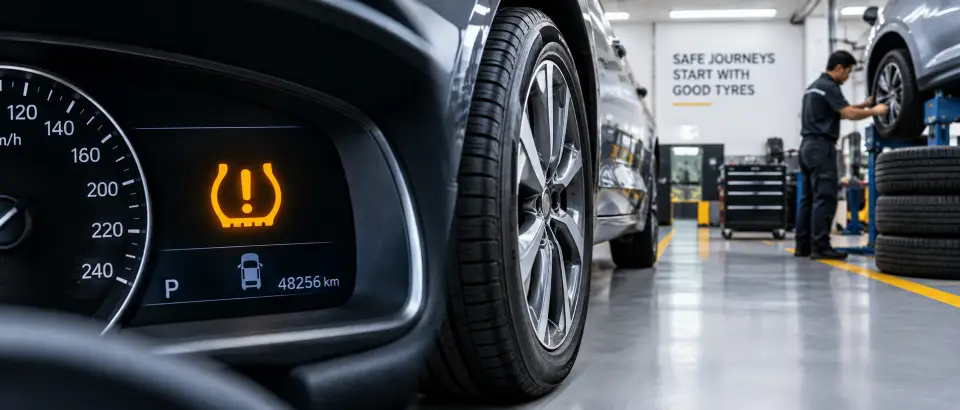
The little yellow horseshoe with the exclamation mark comes on, and the first thing most drivers do is look at the tyres. They all look round. Nothing looks flat. So you carry on and hope it sorts itself out.
Here is the short answer first. In most cases you can drive a short distance at reduced speed to somewhere you can check the tyres. What you should not do is keep driving for days with the light on, because by the time it appears you have usually lost far more air than you would guess by looking.
The rest explains why it came on, how to tell a pressure problem from a system fault, and when the answer changes from “drive carefully to a petrol station” to “stop now.”
First, Is the Light Steady or Flashing?
This is the single most useful thing to check, and almost nobody knows it.
- Steady light. At least one tyre is significantly under-inflated. The system is working correctly and reporting a real pressure problem.
- Flashing, then steady. The system itself has a fault. NHTSA describes this pattern specifically: if the light flashes for 60 to 90 seconds at startup and then stays lit, that indicates a malfunction in the monitoring system and the vehicle should be inspected.
- Light cycling on and off. NHTSA notes this usually means the tyres are marginally low rather than badly down, and should be checked.
The difference matters. A steady light is about your tyres. A flashing light is about the system that watches your tyres, which means it may no longer be able to warn you about a real problem. Both need attention, but different attention.
A flashing light is also where some drivers come unstuck. They decide the system is faulty and ignore it, but a faulty system cannot tell them when a tyre actually does go down.
What the Light Actually Measures
The warning does not trigger the moment a tyre dips below ideal. It triggers once the tyre is already well down.
Bridgestone describes the threshold as pressure dropping 25 percent or more below the correct pressure. Put that against a real number. If your car’s recommended pressure is 33 PSI, 25 percent below is roughly 25 PSI. You have lost about 8 PSI before the light says anything.
That gap explains two things drivers find confusing.
- Your tyres can be noticeably low with no light showing. A tyre at 28 PSI against a recommended 33 hurts wet grip, fuel economy and tyre life, and the light stays off.
- A tyre that looks fine can still set the light off. Radial tyres barely change shape until they are very low, so judging pressure by eye is close to useless. That is why the light exists at all.
NHTSA puts it plainly: TPMS is not intended to be a substitute for regular tyre maintenance. The light is a last line of defence, not a pressure gauge.
Two Kinds of TPMS, and Why It Changes the Answer
Not all systems work the same way, and the type your car has affects how much you can trust the warning.
Direct TPMS
Sensors sit inside each wheel and measure actual pressure, often temperature too. Bridgestone notes each sensor carries a unique serial number and sends readings wirelessly to a control module, and that sensor batteries usually last about a decade. The battery is sealed inside, so when it runs out the whole sensor is replaced.
This is the system that shows individual pressures per wheel on the dashboard. It is accurate and it keeps working when the car is parked.
Indirect TPMS
There are no sensors in the wheels. The system uses the ABS wheel speed sensors instead. A tyre losing pressure gets slightly smaller in rolling diameter, so it turns a little faster to cover the same ground. The car spots that difference and lights the warning.
Bridgestone is clear that indirect TPMS does not actually measure tyre pressure. That has real consequences:
- If all four tyres lose pressure evenly, which happens naturally over months, the wheels still turn at matched speeds and the system may never notice.
- It has to be reset after you inflate or rotate the tyres, or it keeps comparing against the old baseline.
- Changing to a different tyre size can throw it off.
With indirect TPMS, treat monthly manual checks as essential rather than optional. The system is only good at catching one tyre going down faster than the rest.
Why the Light Came On
Running through the likely causes in rough order of how often they turn up.
- A slow puncture. A screw or nail in the tread can leak over days without ever going properly flat. The most common single cause, and worth finding early, since a puncture in the central tread area is usually repairable. Our page on car tyre puncture repair covers which punctures can and cannot be fixed.
- Normal air loss over time. Tyres lose pressure gradually through the rubber and around the valve, with no damage at all. A tyre nobody has checked in six months can easily be down enough to trigger the light.
- A leaking or corroded valve. The valve stem is a wear item. Rubber valves perish, and metal stems on direct TPMS sensors can corrode where the stem meets the sensor body.
- Temperature. Pressure rises and falls with temperature. Our weather does not swing like a European winter, but a car parked in the open all afternoon reads differently at 7am. If the light appears early and clears later in the day, that tyre was already marginal.
- New tyres fitted and the system not reset. Particularly on indirect systems, which need to relearn.
- A flat sensor battery. On direct TPMS, after roughly a decade. This usually shows as the flashing fault pattern rather than a steady light.
- A sensor damaged during fitting. Sensors sit on the inside of the wheel and can be knocked by a tyre machine if the fitter is careless. Worth knowing before choosing where to have tyres fitted or wheel balancing done.
- The spare. Some vehicles monitor a full size spare. If three tyres check out fine, look in the boot.
So Is It Safe to Keep Driving?
It depends on what you find when you look.
Drive on with care, to the nearest place you can add air, if:
- The light is steady, the car drives and steers normally, and no tyre looks visibly flat.
- The light has only just appeared on this journey.
- You can keep your speed down and avoid heavy braking or sharp steering.
Treat it as a short trip to a petrol station, not a normal day of driving. A tyre at 25 PSI has longer wet stopping distances and runs much hotter than it should, and heat is what turns a soft tyre into a failed one.
Stop as soon as it is safe to do so if any of these apply:
- The steering has gone heavy or the car pulls to one side. That points to one tyre being much lower than the rest.
- A tyre is visibly flat or sagging. Driving on a flat destroys the sidewall within a very short distance, turning a repairable puncture into a replacement.
- You hear rhythmic flapping or slapping, or feel a vibration that was not there before.
- A bulge, cut or object is visible in the tyre.
- The light came on suddenly with a bang or a change in how the car feels. That is rapid deflation, not a slow leak.
If the light flashes then stays on, the system has a fault. Nothing has told you a tyre is low, but you are now driving without a working warning. Check all four pressures by hand and get the system looked at.
What to Do When You Get Somewhere Safe
The order matters here.
- Find the correct pressure first. It is on a label inside the driver’s door jamb, sometimes in the fuel filler flap or glovebox, and in the owner’s manual. NHTSA is specific that you use this figure, not the number moulded on the tyre sidewall. The sidewall number is the tyre’s maximum, not your car’s recommendation.
- Check when the tyres are cold. NHTSA defines cold as not driven for at least three hours. Driving heats the air and raises the reading, so topping up a hot tyre to the placard figure leaves it under-inflated once it cools. If you must inflate warm, add a couple of PSI and recheck properly later.
- Check all four, plus the spare, and note which was low and by how much. Three PSI down is a top-up. Twelve PSI down is a leak.
- Inflate to the recommended figure, then drive and see whether the light goes out.
- If that tyre is low again within a few days, it has a puncture or a valve leak. Topping it up repeatedly is not a repair.
Why the Light Sometimes Stays on After Inflating
This frustrates a lot of drivers. A few explanations, in the order worth checking.
- It needs a short drive. Many systems only re-evaluate above a certain speed, so the light can take several minutes to clear.
- You missed one. Usually the spare, or a tyre inflated with a gauge reading a few PSI high.
- Indirect systems need a manual reset. There is often a button or menu item to relearn the baseline. Resetting before correcting the pressure just teaches the car that low is normal, so always inflate first.
- A sensor has failed. If pressures are correct against a reliable gauge and the light stays on, the system needs diagnosis.
One thing worth saying clearly. Do not deal with a persistent light by having the system disabled. That removes a safety warning instead of fixing anything.
What the Light Does Not Tell You
Drivers tend to over-trust the system, so the limits are worth stating.
- It does not tell you tread depth. A tyre at perfect pressure with 1.6mm of tread is still a wet weather risk.
- It says nothing about sidewall damage, age cracking or a bulge.
- It says nothing about uneven wear from alignment being out.
- On indirect systems it may not notice all four tyres going down together.
- It does not catch slow decline. A tyre drifting from 33 to 28 PSI over months stays invisible to it.
Which is why the monthly manual check still matters, and why a professional tyre inspection covers things the dashboard never will.
Getting It Sorted
At Swift Tyre Specialist we check all four tyres and the spare with a proper gauge, find the leak rather than just topping it up, and tell you whether it is a repair or a replacement.
If the puncture is in the central tread area and the tyre is otherwise sound, car tyre repair is usually the right answer and the cheaper one. Sidewall and shoulder damage cannot be safely repaired on any tyre, and we will say so rather than patch it and send you off, then talk through tyre replacement options.
If the tyre is flat where you are parked, we come to you. Call +65 8484 3838, or bring the car to our car repair workshop at Kaki Bukit.
Frequently Asked Questions
Q: Can I drive with the TPMS light on?
A: For a short distance at reduced speed, usually yes, provided the car drives normally and no tyre is visibly flat. Head straight to somewhere you can check and inflate. Stop immediately if the steering changes, the car pulls, or you hear flapping from a wheel.
Q: What does a flashing TPMS light mean?
A: It indicates a fault in the monitoring system rather than low pressure. NHTSA describes the pattern as flashing for 60 to 90 seconds at startup and then staying lit. Check your pressures manually, since the system can no longer warn you reliably, and get it diagnosed.
Q: Why is my TPMS light on when the tyres look fine?
A: Because a radial tyre barely changes shape until it is very low. The light triggers at roughly 25 percent below the recommended pressure, which on a typical car means about 8 PSI lost. That is easily enough to matter and far too little to see.
Q: How do I reset my TPMS light?
A: Inflate every tyre to the correct pressure first, then drive for a few minutes. Many cars clear the light on their own. Indirect systems often need a reset button or menu option. Never reset before correcting the pressure, or the car learns the wrong baseline.
Q: How long do TPMS sensors last?
A: Bridgestone puts direct TPMS sensor batteries at roughly a decade. The battery is sealed inside, so when it runs out the whole sensor is replaced. Worth checking sensors whenever tyres are changed, since they can be damaged during fitting.
Q: Does TPMS replace checking my tyres myself?
A: No. NHTSA states directly that TPMS is not intended to be a substitute for regular tyre maintenance. It only catches significant pressure loss, and it tells you nothing about tread depth, sidewall condition or uneven wear. Check all tyres monthly when cold.