


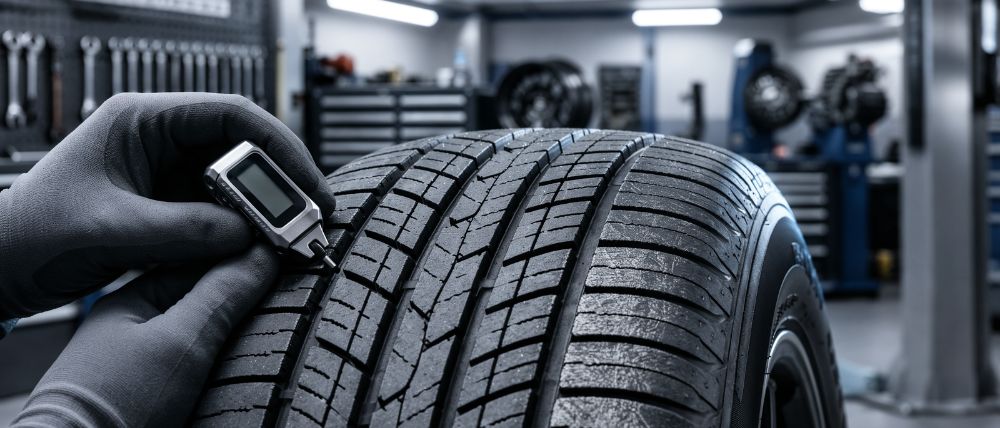
A tyre keeps a record. Every kilometre, the tread is shaped by the pressure inside it, the angle the wheel sits at, the condition of the suspension above it and the way you drive. By the time a tyre is halfway through its life, that record is written across the tread in a pattern anyone can learn to read.
Most drivers never read it. They notice a tyre is “quite worn”, replace it, and six months later the new one wears out the same way. The pattern was never the problem. It was the receipt for a problem elsewhere on the car, and a new tyre just gives the same fault a fresh surface to chew through.
Here is what each pattern looks like, what it points to, and the causes that get missed most often.
Start With What Normal Looks Like
A healthy tyre wears down evenly. Run your hand across the tread from inner edge to outer edge and the depth should feel much the same the whole way, at three or four points around the tyre. The blocks should feel smooth in both directions, with no sharp lips or ridges.
One normal difference is worth knowing before you worry about it. On most cars the front tyres wear faster than the rears, often considerably faster, because they steer, carry the engine’s weight and on a front wheel drive car put the power down too. A front pair at 4mm with a rear pair at 6mm is usually just the car being a car.
What matters is unevenness across one tyre, or one tyre wearing far faster than its partner on the same axle. Bridgestone makes the underlying point neatly: a manufacturer sets front and rear pressures so that the recommended inflation pressures ensure an even distribution of vehicle load across the tread. Even wear means that load is still spread the way it was meant to be.
Reading the Six Patterns
Michelin’s wear reference sets out what each pattern indicates. The fix is different for every one, so they are worth taking in turn.
Worn Down the Middle, Edges Still Good
The centre band is noticeably shallower than either shoulder. Measure across and the middle may be 3mm while the edges are still 5mm.
Michelin attributes this to chronic overinflation. Too much air bulges the tyre outward in the centre of its footprint, so the middle carries a disproportionate share of the load and the shoulders barely touch the road. You end up on a narrower contact patch than the car was designed around, which means less grip for braking and cornering.
The cause is usually a habit: inflating to the number on the tyre sidewall instead of the one on the door jamb label. The sidewall figure is the tyre’s maximum, not your car’s recommendation.
Worn on Both Outer Edges, Middle Still Good
The mirror image. Both shoulders are down while the centre still has depth.
Michelin’s cause here is chronic underinflation. A soft tyre flexes and the centre lifts slightly off the road, so the two shoulders carry the car.
This deserves more respect than it gets, because underinflation does not only wear the edges. It builds heat in the sidewalls, and heat is what turns a soft tyre into a failed one. A tyre showing this pattern has been under-pressure for months, so the damage inside may be worse than the tread suggests.
Worn on One Edge Only
One shoulder is worn, often sharply, and the rest looks fine. Inner edge wear is the common version and the easiest to miss, because the worn side faces under the car where nobody looks.
Michelin is direct about this one: wear on one edge only points to an alignment problem. The wheel is not sitting square to the road, so one shoulder drags while the rest of the tread rolls.
This is the pattern most worth catching early. It eats a tyre quickly once it starts, and it often comes with no driving symptom at all. A car with a camber problem on one rear wheel can feel completely normal through the steering while quietly destroying a tyre from the inside edge. Our page on wheel alignment and balancing covers what gets measured and adjusted, and we have explained caster, camber and toe separately.
Feathering, Where Each Tread Block Has a Sharp Side
You find this with your hand rather than your eyes. Run your palm sideways across the tread one way and it feels smooth. Run it back and it catches, because each block has worn to a sharp edge on one side and a rounded edge on the other.
Michelin puts feathering down to a toe alignment issue. Toe is the angle the wheels point relative to straight ahead. When it is out, the tyre is scrubbed sideways slightly with every revolution, and that shaves one side of each block.
Feathering is useful because you can find it before the tyre looks worn, which makes it an early warning that the geometry has shifted, often after a kerb strike or a deep pothole.
Cupping, or Scalloped Dips Around the Tyre
Patches of wear spaced around the circumference, so the tread rises and falls instead of sitting level. Easier to feel than see, and it often comes with a droning noise that changes with speed.
Michelin links cupping and scalloping to a balance or suspension issue, naming wheel imbalance or worn shock absorbers as the causes.
The mechanism explains why cupping warns about more than the tyre. A shock absorber keeps the tyre pressed against the road. When it is worn the wheel bounces instead of staying planted, and each bounce lands with extra load, scuffing a dip. Those dips then make the bouncing worse. A cupped tyre on a car with tired shocks also has longer stopping distances, since a tyre in the air is a tyre not braking.
Flat Spots
A single localised patch worn far more than the tread around it, sometimes down to the cords.
Michelin attributes flat spots to wheel lock from hard braking, or to extended stationary storage. The braking version is a skid that dragged one spot of rubber across the tarmac. The storage version comes from a car left parked in one position for a long stretch, where the loaded part takes a set.
A braking flat spot is permanent, and a deep one leaves the tyre unbalanced and unsafe however good the rest of the tread looks.
Two Causes People Rarely Check
Pressure and alignment get the blame for nearly all uneven wear, and between them they do explain most of it. Two other causes turn up often enough to name, because both get misdiagnosed as alignment and both come back after a fresh alignment.
Worn suspension and steering components. This is the big one. Bridgestone Singapore makes the point directly: worn parts such as tie rod ends, control arm bushings or shock absorbers can cause uneven wear that looks similar to aggressive toe or camber problems, and the car should go to a workshop for a thorough diagnosis.
That has a real consequence. If a worn bush lets a wheel move under load, an alignment machine still reads the car as within specification while it sits still on the rack. The geometry is correct parked and wrong when driving. Which is why a tyre can wear unevenly again within months of an alignment done properly. The alignment was not wrong. The component holding the angle was. Our car repair workshop handles that diagnosis, and suspension parts are worth a look at each car servicing visit rather than only once a tyre is ruined.
How and where the car is driven. Carrying heavy loads regularly, or taking the same carpark ramps and tight corners daily, loads the outer shoulders harder than open-road driving. Nothing to fix. Just worth knowing before you spend money chasing a geometry problem that does not exist.
Which Corner Wears Out Is a Clue
Replace the same corner twice while the other three stay fine and the problem is attached to that corner, almost certainly geometry or a worn component on that side. Fix the cause first, or you pay for the diagnosis with a brand new tyre. It works in reverse too: if all four are wearing unevenly the same way, look at pressure and at how the car is used before the suspension, since one habit is likelier than four faults.
How to Read Your Own Tyres in Five Minutes
Worth doing once a month, in daylight, with the car on level ground.
- Use your hand, not just your eyes. Depth differences are far easier to feel than see. Run your palm from inner edge to outer edge, then sideways across the blocks both ways to check for feathering.
- Check the inner edge properly. Turn the steering to full lock to swing the front wheels outward and expose the inner shoulder. This is where one-sided wear hides.
- Measure rather than guess. A tread depth gauge costs very little. Take readings at the inner edge, centre and outer edge, at two or three points around each tyre, and write them down. The differences between those numbers are the diagnosis.
- Find the wear indicator bars. Small raised blocks sit in the main grooves at 1.6mm, which Bridgestone notes is where LTA legally requires tyres to be replaced. Tread level with those bars anywhere means that tyre is finished.
- Keep the readings. This month against three months ago tells you whether a pattern is developing or has been there since you bought the car.
If you would rather have it measured properly, a professional tyre inspection gives you depths across each tyre instead of an impression.
What Wear Patterns Cannot Tell You
Tread reading is a starting point, not a diagnosis. A pattern narrows the field without naming which component is at fault. Inner edge wear on a rear tyre could be camber, toe or a worn bush, and telling those apart needs the car on a machine.
Tread also says nothing about the parts you cannot see. A tyre with textbook even wear can still have sidewall damage, age cracking or internal separation from a pothole strike. And patterns form over months, so they catch a developing fault and miss anything that happened last week.
Getting the Cause Found, Not Just the Tyre Changed
At Swift Tyre Specialist we would rather find out why a tyre wore out than sell you another one. We measure tread across each tyre, check pressures against your car’s own specification, and use a Hunter Hawkeye computerised alignment system with a road test and a printed report before we call the job done.
If the pattern points at geometry, that report tells you what was out and what was corrected. If it points at a worn component instead, we will say so, because an alignment on a car with a failing bush buys you nothing. Where the tyre is past saving, we will talk through tyre replacement options and fit at the workshop in Kaki Bukit or onsite. Call +65 8484 3838 with what you found on the tread.
Frequently Asked Questions
Q: Is it normal for front tyres to wear faster than rear tyres?
A: Yes, on most cars. The front wheels steer, carry the engine’s weight, and on front wheel drive cars deliver the power too. A front pair wearing noticeably faster is usually ordinary. What is not normal is uneven wear across a single tyre, or one tyre wearing much faster than its partner on the same axle.
Q: Can I just replace a tyre that has worn unevenly?
A: You can, but unless the cause is found the new one wears the same way. If the pattern points to pressure, correct it before fitting. If it points to geometry or a worn component, check that first.
Q: Does uneven wear always mean the alignment is out?
A: No. Centre and both-edge wear are pressure problems. Cupping points at balance or suspension. And worn suspension parts can produce wear that looks like an alignment fault while the car still measures within specification on the rack, which is why Bridgestone recommends a thorough workshop diagnosis rather than assuming.
Q: What is feathering and how do I check for it?
A: Each tread block wears to a sharp edge on one side and a rounded edge on the other, which Michelin attributes to a toe alignment issue. Run your palm sideways across the tread both ways. Smooth one way and catching the other means feathering, and it appears well before the tyre looks worn.
Q: Should I rotate my tyres to even out the wear?
A: Rotation spreads wear across a set and can extend the life of all four, but it fixes nothing. Rotating tyres on a car with a geometry or suspension fault just distributes the damage. Fix the cause, then rotate. Follow your manufacturer’s guidance, since recommendations vary and some tyres are directional.
Q: I hit a kerb and the tread still looks fine. Am I clear?
A: Not necessarily. An impact can shift the geometry immediately while the wear takes months to show. Feel for feathering, which appears earliest, and if the car has started pulling or the steering wheel sits off centre, have the alignment checked rather than waiting for a pattern to develop.