


Most drivers only learn what an alternator does after it stops working. By that point, they are usually stuck on the road somewhere, wondering why the car died despite having a fairly new battery.
It happens more often than you would think here in Singapore. The heat puts constant stress on engine components, and the alternator is no exception. It runs every time you drive, powering everything from your headlights to your air conditioning, so when it starts to go, the rest of the car feels it quickly.
The good news is that a failing alternator almost always gives you plenty of warning before it completely breaks down. You just need to know what to look for.
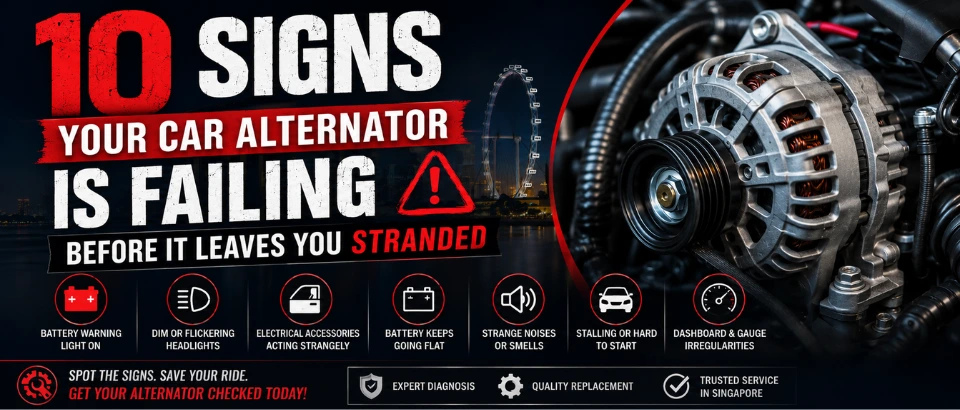
Here are 10 signs that your alternator is struggling, and what to do about each one.
What Does the Alternator Actually Do?
Before diving in, a quick explanation helps. The alternator is a generator that sits at the front of the engine, driven by a belt. While the engine is running, it produces electricity that powers all the electrical systems in your car and continuously recharges the battery.
Think of it this way. The battery starts the car. The alternator keeps it running.
When the alternator fails, the car draws power from the battery alone. The battery was never designed to do that job for long, so it drains fast. Depending on how much power your car uses, a failing alternator can drain the battery in as little as 30 minutes of driving.
10 Warning Signs of a Failing Alternator
1. The Battery Warning Light Comes On
This is the most obvious sign, but it gets misread all the time. Drivers see the battery light and assume the battery is the problem. Not always. That warning light monitors the voltage in your charging system, which includes the alternator.
If the light comes on while you are driving with the engine running, it is more likely the alternator than the battery. A working alternator keeps voltage between 13.5 and 14.5 volts. If it drops below that range, the warning light activates.
Do not ignore it. The light is telling you that something in the charging system is off.
2. Dim or Flickering Headlights
Your headlights are powered by the alternator while the engine is running. When the alternator starts to weaken, one of the first places you will notice it is in the quality of your lights.
Headlights that look dimmer than usual, or that flicker when you accelerate or brake, are a classic sign. You might also see the dashboard lights brighten and dim as you rev the engine up and down.
This happens because the alternator is struggling to maintain a consistent output. The voltage is fluctuating, and the lights are just reflecting that instability.
If your lights look weak, especially in the evening, take it seriously. Dim headlights are not just a nuisance. They reduce visibility and can be a safety risk on Singapore’s busy roads.
3. Electrical Accessories Acting Strangely
Modern cars rely on a constant, stable supply of electricity to run everything properly. When the alternator is not providing that, electrical systems start behaving oddly.
You might notice the power windows moving more slowly than usual. The air conditioning might not cool as well. The radio could cut in and out. The infotainment screen might freeze or restart randomly.
Some cars are programmed to shut down non-essential systems automatically when they detect low voltage. This is a built-in protection mechanism, but it is also a sign that something is wrong.
If several electrical accessories are misbehaving at the same time, the alternator is a strong suspect.
4. The Car Battery Keeps Going Flat
Here is where a lot of people get confused. You replace the battery, the car works fine for a few days, and then it goes flat again. You replace it a second time and the same thing happens.
This is one of the clearest signs of an alternator problem. The battery is going flat because the alternator is not charging it while you drive. So no matter how new or healthy the replacement battery is, it keeps draining because nothing is putting power back in.
If your battery has gone flat more than once in a short period, stop replacing batteries and get the alternator tested. You will save yourself a lot of money.
You can read more about what to check when your car battery keeps dying on our battery service page.
5. Strange Whining or Grinding Sounds from the Engine Bay
Not all alternator problems are electrical. Sometimes they are mechanical, and they make noise.
A whining or grinding sound coming from the front of the engine can mean that the bearings inside the alternator are wearing out. Bearings allow the internal rotor to spin smoothly. When they go, the alternator makes noise.
You might also hear a squealing sound, which can come from the alternator belt if it is loose or worn. The belt drives the alternator, so if it slips, the alternator cannot spin fast enough to generate proper voltage.
The tricky part is that these sounds can also come from other components like the power steering pump or air conditioning compressor. If you hear something new from the engine area, get it checked rather than guessing.
6. A Burning Smell You Cannot Explain
A burning smell from under the bonnet is never something to dismiss. If it smells like burning rubber or hot wire insulation, the alternator is one of the first things to inspect.
The alternator belt, if it is slipping or misaligned, can heat up and produce a rubber burning smell. Overloaded wiring connected to a struggling alternator can get hot enough to produce a smell like burnt plastic.
Neither of these smells should be ignored. Pull over safely, switch the engine off, and do not try to continue driving.
7. The Car Stalls While Driving or Is Hard to Start
An alternator that is failing badly can cause the engine to stall while you are driving. This happens because the battery gets so depleted that the car cannot maintain the electrical demand of the engine management system.
You might also find the car hard to start, especially after a short stop like picking someone up or filling up with petrol. The engine cranks sluggishly, or takes a few tries to fire up, because the battery did not get recharged during the brief drive.
Stalling while driving is dangerous regardless of the cause. If your car has been cutting out unexpectedly, get it looked at right away.
8. Dashboard Gauges and Instruments Going Haywire
Have you ever seen the fuel gauge drop to zero while driving, or the speedometer jump around for no reason? When the alternator’s voltage output becomes erratic, it can interfere with the accuracy of dashboard sensors and gauges.
This is more common in newer cars with complex electronic systems that depend heavily on stable voltage. Older vehicles tend to be less sensitive to this, but any car can show dashboard irregularities when the charging system is unstable.
If gauges that were working perfectly fine suddenly start behaving strangely, and you cannot think of any other reason why, the alternator is worth checking.
9. Frequent Fuse Failures
Fuses protect individual circuits by breaking the connection if too much current flows through. When the alternator puts out voltage that is too high or too low, it can cause unusual stress on circuits throughout the car.
This sometimes shows up as fuses that blow more frequently than they should. If you are replacing the same fuse repeatedly without any obvious reason, the issue might not be with the circuit itself but with the power supply feeding it.
An alternator that is overcharging the battery is just as problematic as one that is undercharging. Both can damage electrical components over time.
10. The Car Dies Shortly After a Jump Start
This one catches people off guard. You get a jump start and the car starts fine. You drive off feeling relieved. Then 20 or 30 minutes later, the car dies again.
A healthy battery with a working alternator should stay charged after a jump start. If the car dies again quickly, it means the alternator is not picking up where the jump start left off. The battery ran out of charge again because nothing was replenishing it.
This is one of the most reliable indicators of an alternator fault. If a jump start only buys you a short window before the car dies again, the alternator is failing.
Alternator vs Battery: How to Tell the Difference
Since the symptoms overlap so much, it helps to know how to distinguish between the two.
| Symptom | More Likely Battery | More Likely Alternator |
|---|---|---|
| Car will not start in the morning | Yes | Possible |
| Battery warning light on while driving | No | Yes |
| Car dies while driving | Unlikely | Yes |
| Jump start fixes it for days | Yes | No |
| Jump start only lasts minutes to hours | No | Yes |
| Lights dim while driving | Possible | Yes |
| Multiple electrical faults at once | No | Yes |
If the jump start holds for several days, the battery is probably the weak point. If the car dies again the same day or within a short drive, suspect the alternator.
What to Do If You Suspect an Alternator Problem
The most important thing is not to leave it. Alternators do not fix themselves, and a partial failure will become a complete one.
Here is what to do:
- Get the alternator tested. Most workshops can test the output voltage quickly. A reading below 13.5 volts with the engine running usually confirms a charging problem.
- Do not just replace the battery. If the battery is going flat regularly, test the alternator first before spending money on a new battery that will drain the same way.
- Avoid driving long distances on a suspected failing alternator. The battery only has limited reserve, and once it is gone the car will stop wherever you happen to be.
- Switch off non-essential electrics. If you need to get to a workshop urgently, turn off the air conditioning, radio, and any other accessories to extend your battery’s reserve.
At Swift Tyre Specialist, we offer professional car alternator replacement in Singapore with quality parts that are suited to local driving conditions. Our team tests the full charging system before and after replacement to make sure everything is working properly.
Can You Prevent Alternator Failure?
You cannot make an alternator last forever, but a few habits help extend its life.
- Get the alternator belt inspected at every major service. A worn or cracked belt reduces alternator output before the alternator itself fails.
- Avoid overloading your car’s electrical system with aftermarket accessories that draw heavy power.
- Do not leave the car idling for long periods with heavy electrical loads like air conditioning on full blast and all lights on. This puts the alternator under sustained stress.
- Keep the battery in good condition. A badly sulfated battery can actually cause the alternator to overwork, leading to earlier failure.
- Get the charging system tested once a year, especially if the car is more than 4 years old.
For most Singapore drivers, the combination of daily short trips, heavy traffic, and constant air conditioning use puts the alternator under more stress than average. Routine checks go a long way.
Conclusion
A failing alternator does not usually give out all at once. It fades gradually, dropping hints along the way. Dim lights, a flat battery that keeps coming back, strange smells, flickering gauges, a car that dies after a jump start. Each one is a clue.
The drivers who catch it early save themselves a roadside breakdown and often a lot of unnecessary expense from repeatedly replacing a battery that was never the real problem.
If you have noticed any of these signs, get the charging system tested sooner rather than later. And if the alternator does need replacing, make sure it is done at a workshop you trust, with parts that will last.
Swift Tyre Specialist provides onsite car alternator replacement across Singapore. If you are unsure whether the problem is the alternator, the battery, or something else entirely, our team at the car repair workshop can run a full diagnostic and give you a straight answer.
Call us at +65 8484 3838 and we will help you sort it out.
FAQ Section
Q1: How do I know if it is my alternator or my battery that is the problem?
The easiest way to tell is to see what happens after a jump start. If the car runs fine for several days after being jumped, the battery is the weak point. If the car dies again within minutes or hours of a jump start, the alternator is not recharging the battery and is likely the problem.
Q2: How long does a car alternator last in Singapore?
Most alternators last between 100,000 and 150,000 km, but this can be shorter for cars driven heavily in Singapore’s heat with constant air conditioning use. Regular servicing and belt inspections help extend alternator life.
Q3: Can I still drive with a failing alternator?
You can, but only briefly. Once the alternator stops charging the battery, the car runs entirely on battery power. Depending on your car and how many accessories are running, this might last anywhere from 20 minutes to an hour before the car dies. It is not safe to drive any distance with a known alternator fault.
Q4: Will a new battery fix an alternator problem?
No. If the alternator is faulty, a new battery will drain in the same way the old one did. Replacing the battery without fixing the alternator is a waste of money. Always test the charging system before deciding which component to replace.
Q5: What does a failing alternator sound like?
A failing alternator can make a whining or grinding noise from the engine bay, usually caused by worn internal bearings. You might also hear a squealing sound from the alternator belt if it is loose or slipping. If the sounds change with engine speed, the alternator or belt is a likely source.
Q6: How much does car alternator replacement cost in Singapore?
The cost varies depending on the car model, the brand of replacement alternator, and the workshop you use. Labour and parts together typically range from a few hundred to over a thousand dollars for some models. Getting a quote from a trusted workshop like Swift Tyre Specialist is the best way to get an accurate figure for your specific vehicle.