


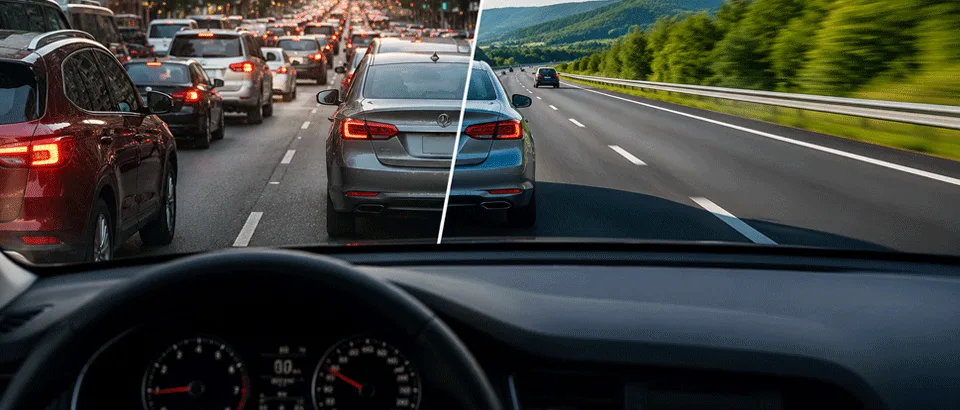
Each car owner uniquely uses their car. Some drive most of the time in city traffic, while others regularly travel on highways for longer journeys. Both driving techniques can take you to the same location, but they have an impact on your vehicle that is totally different.
City driving is typically associated with frequent stops, short trips, frequent acceleration and traffic congestion. In highway driving, however, the cars are allowed to maintain stable speeds for longer periods. The variations will have a significant influence on fuel economy, engine performance, tyres, brakes, maintenance needs and so on.
City and highway driving conditions can cause significant damage to a vehicle if you are not aware of the effects. With the knowledge of the effects of city and highway driving, you can keep your car in better condition and keep repair costs lower, and extend its life.
The impact of urban driving on vehicles
The effects of urban driving on vehicles.
City driving is the most challenging on the car as they get constant breaks in the process. The increased pressure on several components from stop-and-go traffic.
Increased engine strain
In urban congestion, engines are continually idling, accelerating and braking. The pressure that occurs continuously puts extra wear on engine parts.
Short trips within the city can also keep the engine from operating at an optimum temperature. Thereby, the efficiency of the circulation of the engine oil can be interfered with, and engine oil wear increases with time.
Short periods of cold start every day can also take its toll on engine efficiency and durability.
Higher fuel consumption
Typically, urban driving conditions cause a reduction in fuel economy compared to highway driving. Frequent braking and accelerating increase fuel consumption.
Unnecessary fuel is wasted if vehicles idle at traffic lights or drive slowly in heavy traffic. Modern fuel-efficient cars will also not keep up their mileage during heavy urban traffic.
Faster brake wear
City driving puts a lot of strain on brakes as drivers need to stop often for traffic lights, pedestrians, speed bumps and traffic jams.
Brakes wear out more often with continuous braking because it causes wear on the brake pads and rotors. Those who drive mostly in urban areas may see their brake expenses increase more rapidly.
Stress caused by the clutch and transmission
City driving is particularly difficult for manual transmission cars. Frequent shifting of gears and using the clutch causes components to wear out.
Eventually, the clutch system can overheat when driving in bumper-to-bumper traffic, especially if the driver habitually rides the clutch.
Repeated stop-and-go driving can also cause wear and tear on automatic transmissions.
Battery drain is likely to occur
In urban areas, shorter trips where the ignition is on and off frequently mean that the alternator doesn’t have enough time to recharge the battery.
Meanwhile, other features such as air conditioning, infotainment systems, headlights and charging ports remain in use, further depleting power. This will eventually lead to a weak battery.
The impact of highway driving on your car
The effect of highway driving on your car
Generally, highway driving is easier on most vehicles as the engine runs more smoothly and steadily. But even with highway travel, there are certain maintenance requirements.
Better engine efficiency
In highways, the engine is kept running at a constant speed and temperature. Therefore, engine oil can flow freely and lubrication can be maintained.
Riding steadily minimizes wear and tear in the internal components of your vehicle, as opposed to what it may be in the city when you accelerate and brake frequently.
When you take care of your car, driving on the road can be a better way to live in terms of your health, especially regarding your engine’s health.
Improved fuel economy
Highway driving conditions are more ideal for higher fuel economy since vehicles can travel consistently at one speed without having to stop for traffic.
Minimizing acceleration and braking makes fuel combustion more efficient. This can help to lower gas usage when traveling long distances.
Tour/long-distance vehicles are particularly well-suited for highway service.
High-speed tire wear
Highway driving will decrease stress on the engine and brakes, but will increase the pressure on the tires.
High speed and long hours produce heat within the tires. Worn-out tires or tires that are underinflated can wear out unevenly or not be safe for long trips on the highway.
Highway drivers should have regular tire pressure checks and wheel alignment checks.
Read More: Wheel Alignment and Tyre Pressure: How Both Affect Your Ride
Higher electricity consumption by cooling systems
Greater loads on cooling systems.
When driving on the highway, the engine must operate for extended periods of time. This gives extra load to the cooling system.
When the engine coolant level is low or the radiator is not performing properly, the engine could overheat, particularly in summer driving or when driving uphill.
For long-distance driving, it is essential to regularly check the condition of the coolant and radiator.
Read More: Long Road Trip? How to Ensure Your Car Battery Survives the Trip
Damage to the windshield and exterior surfaces
Exterior and windshield damage.
Vehicles are subjected to dust, gravel, insects, and road debris at greater speeds when driving on the highway. This could result in chips in the windshield or paint damage and scratches on the car’s exterior.
Regular washing and protective coatings are usually necessary for the car, and are often car services that frequent highway users pay for to keep the vehicle looking good.
The difference in maintenance between city and highway driving conditions
The types of maintenance priorities vary according to the driving conditions.
Cars primarily used in urban areas may require:
- Increased frequency of brake checks.
- Regular clutch maintenance
- Engine oil checks due to short trips
- Battery monitoring
- Transmission servicing
Vehicles that are used primarily on highways can need:
- Tire inspections and rotation
- Cooling system maintenance
- Suspension checks
- Wheel alignment
- Cleaning the exterior and windshield
Properly following the maintenance schedule according to driving conditions can enhance the reliability of the vehicle.
Final thoughts
City and highway driving have a distinct impact on your car. Constant braking and accelerating put more wear on the brakes, transmissions, batteries and engines in city driving. Highway driving is usually easier on the engine, but it can place extra stress on the tyres, cooling system and suspension over long distances.
Understanding how your driving habits affect your vehicle can help you avoid unnecessary repairs and extend your car’s lifespan. At Swift Tyre Specialist, we provide professional maintenance and repair solutions to keep your vehicle performing at its best under all driving conditions. Whether you need tyre inspections, wheel alignment, battery checks and replacement or complete car repair services, our experienced team is here to help.