


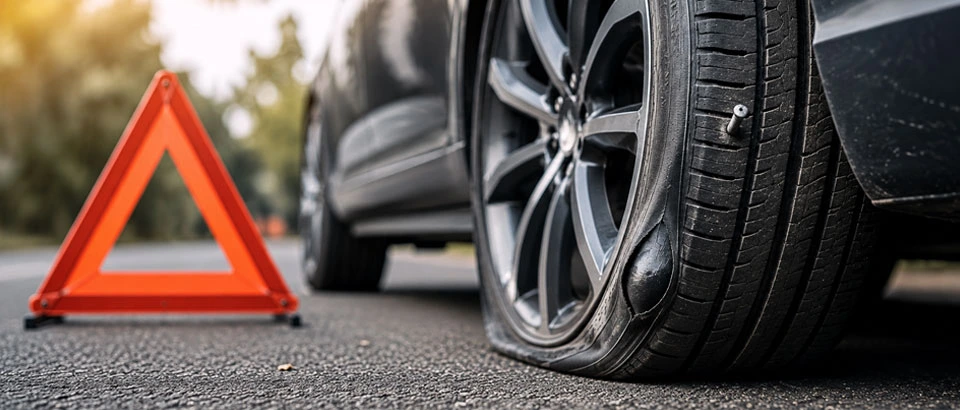
A tyre puncture rarely announces itself at a convenient moment. Most Singapore drivers notice something is off when the car pulls to one side on the AYE, the steering feels sluggish at a red light, or the TPMS warning light flickers on during the morning commute. The instinct is often to hope it is nothing serious and deal with it after work.
That instinct can be genuinely costly, and in some cases, life-threatening.
Not every puncture is the same. A small nail through the centre tread of a healthy tyre is usually a straightforward repair. A split in the sidewall or a tyre that loses air repeatedly overnight is an entirely different situation. Knowing the difference between the two is what separates a quick workshop visit from a high-speed blowout on the PIE.
This guide walks through the seven warning signs that tell you a tyre puncture has moved beyond a minor inconvenience into real danger territory. Along the way, you will find specific guidance for Singapore drivers, including how local road conditions, tropical heat, and LTA regulations affect the decisions you need to make.
Key Takeaways
- Air loss that recurs within hours of inflation signals a failing seal, not a simple puncture.
- Sidewall and shoulder punctures are structurally unrepairable in virtually all cases.
- Singapore’s tropical heat accelerates tyre stress, making rapid professional assessment critical.
- Any puncture larger than 6mm generally cannot be safely repaired.
- A visible bulge or bubble on the sidewall means the tyre’s internal structure is already compromised.
- Singapore’s LTA sets a minimum legal tread depth of 1.6mm; driving below this is an offence.
- A rhythmic thumping sound after a puncture is a sign of serious internal tyre damage.
- When in doubt, replacement is the safer and smarter choice.
Warning Sign 1: The Tyre Keeps Losing Air
If you inflate a tyre and it is noticeably flat again within 24 hours, that is not a slow leak. It is a failing seal, and the distinction matters.
A properly repaired puncture, or an undamaged tyre in good condition, holds its pressure over days and weeks with only minimal natural loss. Rapid air loss after a puncture typically means one of a few things: the object that caused the puncture is still embedded and continues to damage the inner wall each time the tyre flexes; a previous plug repair was insufficient; or the puncture location is in a zone where a reliable seal cannot be created.
Driving repeatedly on an underinflated tyre causes the sidewalls to flex far beyond their design limits. This generates excess heat and can cause internal delamination, ultimately resulting in a blowout. According to the U.S. National Highway Traffic Safety Administration (NHTSA), underinflated tyres run significantly hotter, wear faster, and are substantially more likely to be involved in a crash than properly inflated tyres.
In Singapore, where road surface temperatures regularly exceed 50 degrees Celsius during the afternoon, an underinflated tyre deteriorates far faster than it would in a cooler country. Understanding your recommended tyre pressure and checking it regularly is one of the most effective ways to catch a slow puncture before it becomes dangerous.
What to do: If your tyre drops more than 5 PSI overnight after a puncture, do not keep topping it up and hoping for the best. Get it inspected professionally before driving any further.
Warning Sign 2: A Visible Bulge or Bubble on the Sidewall
This is one of the clearest signals that a tyre needs immediate replacement, not repair.
A bulge forms when an impact (a pothole, a kerb strike, or road debris) breaks the internal structural cords of the tyre. Air then pushes through the weakened section and creates a visible bubble on the sidewall. At that point, the tyre’s structural integrity at that location is already gone.
There is no repair for a sidewall bulge. A tyre with a bulge is at significant risk of sudden blowout, particularly when cornering at speed, braking hard, or travelling on a Singapore expressway. The thinner the remaining rubber over the bulge, the more imminent the failure.
Singapore’s roads, especially in areas undergoing active construction or older residential estates with poor drainage, present pothole and debris hazards that cause this kind of impact damage regularly. Understanding the causes of tyre sidewall bulges and how to prevent them can help you spot the risk before you end up stranded.
What to do: Do not drive on a bulging tyre. Reduce speed, avoid sharp turns, and get to a workshop immediately. If the bulge appears to be growing, pull over safely and call for roadside assistance.
Warning Sign 3: The Puncture Is in the Sidewall or Shoulder Area
Where a puncture sits on the tyre determines whether it can be safely repaired.
A puncture within the central tread area, roughly the flat section between the two shoulder curves, can often be repaired using a proper plug-and-patch method. A puncture in the sidewall or tyre shoulder cannot be safely repaired under any circumstances. These areas flex significantly with every wheel rotation. Any repair material in a high-flex zone will break down under normal driving conditions, and the structural weakness left by the puncture itself will remain.
Most reputable tyre workshops in Singapore will refuse to repair a sidewall puncture precisely because of this. If a workshop offers to fix a sidewall puncture without question, that itself is a warning sign about the quality of the service.
The European Tyre and Rim Technical Organisation (ETRTO) clearly defines repairable zones in its published guidelines and explicitly excludes sidewall and shoulder areas from safe repair.
Understanding your repair options starts with understanding how tyre puncture repair actually works and what a properly assessed repair involves.
What to do: Before agreeing to any repair, ask the technician to show you exactly where the puncture is located on the tyre. If it falls outside the central tread area, insist on replacement.
Warning Sign 4: Tyre Tread Depth Has Dropped Below Safe Limits
A puncture in a tyre with already-worn tread is a compounded problem. The tyre has a reduced safety margin to begin with, and the damage from the puncture makes things worse.
Singapore’s Road Traffic (Motor Vehicles, Construction and Use) Rules set the minimum legal tread depth at 1.6mm across the full circumference of the tyre and across its full width. Driving below this threshold is an offence and can result in fines, demerit points, and LTA vehicle inspection failures.
From a pure safety standpoint, most tyre manufacturers and road safety organisations recommend replacing tyres when tread depth reaches 3mm, particularly in wet conditions. Singapore’s frequent heavy rainfall makes wet-road braking performance critical year-round. Research published by Continental Tyres found that a tyre at 3mm tread depth stopped from 80 km/h in wet conditions significantly faster than a tyre at the legal minimum of 1.6mm, with the difference equivalent to several car lengths at speed.
If your tyre was already approaching wear limits before the puncture happened, the practical and safe decision is replacement, not repair. Patching a near-worn tyre extends its life by weeks at best and carries meaningful risk.
What to do: Use a tread depth gauge or check the wear indicators moulded into your tyre grooves. If the indicators are level with the surrounding tread, the tyre is at or past the legal limit and should be replaced.
Warning Sign 5: You Hear a Flapping, Thumping, or Grinding Sound While Driving
Unusual sounds after a puncture are not a reason to turn the radio up. They are a signal that something has already failed.
A flapping or slapping sound typically means the tyre has lost enough air that the sidewall is folding as the wheel rotates. This is what happens when you drive on a flat tyre, even briefly. The tyre’s internal structure sustains severe damage within a very short distance, often only a few hundred metres, and this damage makes the tyre unrepairable regardless of where the original puncture was.
A rhythmic thumping that speeds up and slows down with the car suggests the tyre has deformed or separated internally. A grinding noise may indicate the rim is contacting the road surface, which means the tyre has failed entirely.
None of these sounds are a “monitor and reassess” situation. They require an immediate, safe stop.
What to do: If you hear any of these sounds, do not continue driving to find a more convenient place to stop. Signal, reduce speed steadily, and pull to the side of the road or into an emergency bay on the expressway. Call for roadside assistance.
Warning Sign 6: The Puncture Is Larger Than 6mm or Has an Irregular Shape
Tyre repair has specific dimensional limits, and they exist for good reason.
Industry guidelines, including those from the Tire Industry Association (TIA), set the maximum repairable puncture diameter at approximately 6mm (roughly the diameter of a standard screw or small nail). A puncture larger than this cannot be reliably sealed because the repair patch cannot fully bond across the damaged area and handle the stresses of driving at speed.
Irregular damage, such as a tear, slash, or gouge, presents the same problem regardless of size. Tears leave ragged edges that do not seal cleanly with patch material, and the surrounding tyre structure around a slash is often weakened even where it appears intact.
Repairing an oversized or irregularly shaped puncture creates a false sense of security. The repair may hold temporarily but is at high risk of failure under load, at speed, or in Singapore’s heat.
Understanding what separates repairable tyre damage from cases where replacement is necessary will help you ask the right questions at any workshop.
What to do: Ask your technician to measure the puncture before proceeding. A professional workshop will do this as standard practice. If they skip this step, ask why.
Warning Sign 7: The Vehicle Pulls Sharply to One Side
Some drift toward a punctured tyre is expected. A tyre losing pressure creates an imbalance, and the car will naturally pull in that direction. But if the pulling is sudden, severe, or accompanied by difficulty holding the steering wheel straight, it is a sign the tyre is failing in real time.
Sudden, sharp pulling at speed is often how a tyre blowout begins. Pressure drops rapidly, the tyre structure collapses on one side, and the vehicle veers. At expressway speeds on the CTE, KPE, or Tampines Expressway, this sequence happens in seconds.
It is also worth noting that a significant puncture, or even a period of driving on an underinflated tyre, can knock a car’s wheel alignment off. After the tyre is repaired or replaced, persistent steering drift or uneven wear on the new tyre often indicates that wheel alignment and balancing needs attention.
What to do: If you experience sudden sharp pulling, do not overcorrect the steering. Hold the wheel firmly, ease off the accelerator gradually, and aim straight. Do not brake hard. Once speed has dropped, steer carefully to the road shoulder.
Repairable vs Non-Repairable Tyre Punctures: A Quick Reference
| Factor | Repairable | Not Repairable |
|---|---|---|
| Puncture Location | Central tread area only | Sidewall, shoulder, or near the rim |
| Puncture Size | 6mm or smaller | Larger than 6mm |
| Puncture Shape | Clean, round hole | Irregular tear, slash, or gouge |
| Tyre Condition | Good tread, no structural damage | Low tread, bulge, cracking, or delamination |
| Air Loss Rate | Slow, stable with inflation | Rapid or recurring within hours |
| Tyre Age | Under 5 to 6 years | Over 6 to 10 years, regardless of appearance |
| Sidewall Condition | No visible damage | Any bulge, crack, cut, or abrasion |
| Internal Damage | None | Tyre has been driven flat, even briefly |
How Singapore’s Road Conditions Increase Tyre Puncture Risk
Singapore drivers face a specific combination of factors that make tyre health more critical here than in many other countries.
Heat and humidity: Road surface temperatures regularly exceed 50 degrees Celsius during the afternoon. High temperatures increase tyre pressure, accelerate rubber compound degradation, and dramatically shorten the safe service window for a tyre that is already compromised. A tyre holding a slow puncture that might last a week in a temperate country may fail within days in Singapore.
Ongoing construction: Singapore’s constant infrastructure activity means road surfaces are frequently disrupted. Debris, uneven transitions between old and new road sections, and temporary surfaces create puncture hazards and impact damage risks that drivers in stable road environments do not face as often.
Kerb contact in urban driving: Tight parking structures, narrow residential roads, and heavy urban traffic increase the frequency of kerb strikes. Kerb contact is one of the leading causes of sidewall damage, internal cord breakage, and the sidewall bulges described in Warning Sign 2.
High traffic density: Singapore’s expressway network is heavily used throughout the day. The consequences of a tyre failure at expressway speed are significantly more serious in a high-traffic environment than on a quiet road.
What to Do When You Spot a Dangerous Puncture
- 1. Stay calm. Grip the steering wheel firmly and reduce speed gradually without braking hard.
- 2. On an expressway, move progressively to the leftmost lane using smooth steering inputs.
- 3. Activate hazard lights immediately.
- 4. Come to a stop in an emergency bay, the road shoulder, or a safe layby. Avoid stopping on live lanes.
- 5. Do not exit the vehicle on an expressway unless there is an immediate safety risk. Call for roadside assistance from inside or from immediately behind the vehicle.
- 6. Contact your insurer’s roadside assistance line, a breakdown service, or the LTA road assistance line.
- 7. Do not change the tyre yourself on an expressway. It is dangerous and there are safer alternatives available.
- 8. Once at the workshop, ask for a visual inspection of all four tyres, not just the one that was damaged.
When Is a Tyre Puncture Too Dangerous to Repair?
A tyre puncture is too dangerous to repair when:
- The puncture is in the sidewall or shoulder area
- The hole is larger than 6mm in diameter
- The damage is a tear or slash rather than a clean round hole
- The tyre has been driven flat, even for a short distance
- There is a visible bulge or bubble anywhere on the tyre
- The tyre tread depth is at or below 1.6mm
- The tyre has rapid or recurring air loss after inflation
In any of these situations, replacement is the correct and safe response.
Conclusion
A tyre puncture sits somewhere on a wide spectrum, from a quick workshop fix to a genuine emergency, and the right response depends on where the damage is, how severe it is, and how quickly you act. The seven warning signs covered here (rapid air loss, sidewall bulges, non-repairable puncture location, critically low tread depth, abnormal driving sounds, oversized or irregular damage, and sudden vehicle pulling) are all signals that a repair may not be enough.
Singapore’s road conditions, climate, and traffic density make it even more important to take these signals seriously. Driving on a compromised tyre in this environment is not a calculated risk worth taking.
If you are not confident about whether a puncture is truly safe to repair, get a professional inspection before making the call. Swift Tyre Specialist can assess the damage, explain your options clearly, and ensure whatever decision you make is based on the actual condition of your tyres rather than guesswork.
FAQs:
Can I drive on a punctured tyre to reach a workshop?
It depends on how quickly air is escaping. A slow puncture with the object still embedded may allow very short-distance low-speed driving, ideally under 3km at speeds below 40km/h. A tyre that is visibly flat, bulging, or making abnormal sounds should not be driven on at all. Driving even a short distance on a completely flat tyre destroys the internal structure and rules out repair.
How do I know if my tyre puncture is in the sidewall?
Crouch beside the tyre and inspect the full outer surface, including the curved zone that transitions from the flat tread area down to the rim (the shoulder area). Any damage outside the flat central tread section is likely in a non-repairable zone. If you are not sure, have a technician assess it before agreeing to any repair.
What is the legal minimum tread depth in Singapore?
Singapore’s LTA requires a minimum tread depth of 1.6mm across the full width and circumference of the tyre. However, most safety organisations and tyre manufacturers recommend replacing tyres at 3mm, especially given Singapore’s wet conditions and frequent heavy rainfall.
Is it safe to use a can of tyre sealant spray in an emergency?
Temporary sealant products are designed for one purpose: to get you to a workshop. They are not a permanent repair. Some formulas can damage tyre pressure monitoring system (TPMS) sensors. Always inform the technician at the workshop that sealant was used, as it needs to be thoroughly cleaned from the inside of the tyre before any proper assessment or repair is carried out.
My TPMS light came on. Does that mean the puncture is dangerous?
The TPMS warning light typically activates when tyre pressure drops around 25% below the recommended level. It is a warning that requires prompt attention, not necessarily a sign of imminent failure. Pull over safely, inspect the tyre visually, and get a professional assessment if the cause is not immediately obvious.
What is the difference between a plug repair and a patch repair?
A plug is inserted into the puncture from outside the tyre without removing it from the rim. A patch is applied to the inside of the tyre after it has been removed and dismounted. The industry-standard repair combines both methods, sealing the damage from the inside with a patch and stabilising it from outside with a plug. A plug-only repair is considered temporary and is not recommended as a permanent solution. You can read more about the differences between tyre plugging and tyre patching to understand what to expect from a proper repair.
Can a tyre be repaired more than once?
Most reputable workshops will not perform a second repair in or near the same area. Multiple repairs weaken the tyre structure incrementally. If your tyre has been previously repaired, factor that history into the current repair-versus-replace decision.
Should I replace all four tyres if one is beyond repair?
Not necessarily, but it depends on the condition of the other three. If the remaining tyres have significantly more tread depth than the new replacement tyre, there can be a size mismatch that affects handling, particularly on all-wheel-drive vehicles. A qualified tyre specialist can advise based on your vehicle type and the current state of your other tyres.
How long does a professional tyre repair take in Singapore?
A proper plug-and-patch repair, following correct industry procedure, takes approximately 20 to 40 minutes. If a workshop completes the job in under 10 minutes, it is almost certainly a plug-only repair without internal patching. That is not a repair standard you want to rely on.
How does Singapore’s climate affect tyre puncture risk?
High ambient temperatures and intense sunlight accelerate rubber degradation, increase internal tyre pressure, and shorten the service life of already-compromised tyres. A tyre that might hold a slow puncture for a week in a cooler country may fail within days in Singapore. Regular tyre pressure checks and prompt attention to any puncture are more important here than in temperate climates.
What should I do if I get a puncture on a Singapore expressway?
Do not brake sharply or overcorrect the steering. Reduce speed gradually, signal and move to the leftmost lane, and come to a stop in an emergency bay. Activate your hazard lights. Do not attempt to change the tyre yourself on an expressway. Call your insurer’s roadside assistance line or LTA’s road assistance service, and remain in or immediately behind the vehicle until help arrives.
At what age should a tyre be replaced regardless of condition?
Most tyre manufacturers recommend replacing tyres between six and ten years from the manufacturing date, regardless of how much tread remains or how the tyre looks on the surface. The rubber compound deteriorates with age and UV exposure even when the tyre is not in use. In Singapore’s heat and sunlight, this degradation occurs faster than in cooler countries. Check the DOT code on the sidewall to find the manufacturing week and year.