


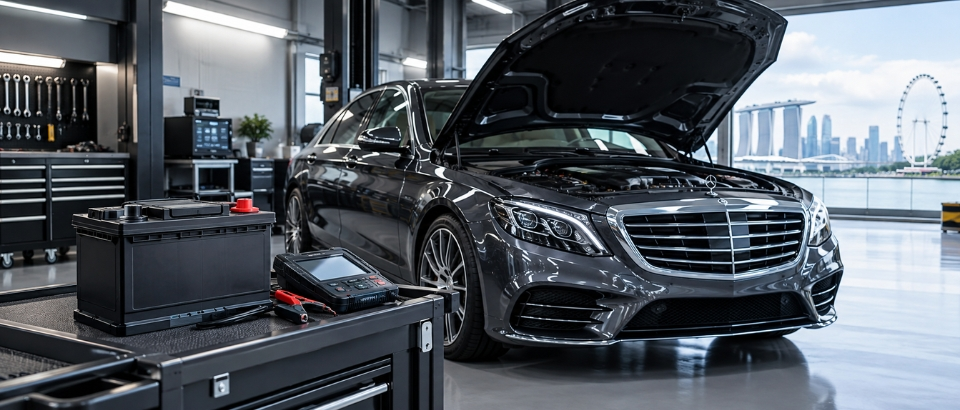
You get a quote to replace the battery in your BMW, Mercedes, Audi or Volvo, and the number is two or three times what your friend paid for their Toyota. The natural reaction is to assume someone is taking advantage.
Sometimes that is true. Often it is not. Premium cars really do have different battery requirements, and the difference is not marketing. It comes down to the type of battery the car was designed around, the software that manages it, and where the thing sits in the car. This article explains those differences, so you can tell a fair quote from a padded one.
Most modern luxury and continental cars need a specific type of battery, not just a specific size. Many also need the new battery registered with the car’s computer after fitting.
Fitting the wrong type usually still starts the car, which is exactly why the mistake is so common. The problems show up months later as a battery that dies early, or as comfort features quietly switching themselves off.
What Changed Under the Bonnet
Twenty years ago a car battery had one real job: turn the starter motor. Everything else ran off the alternator once the engine was going.
That is no longer how these cars work. VARTA, one of the largest automotive battery manufacturers, describes the modern battery as part of a complex electrical system rather than just a starting device, powering comfort and fuel saving functions such as air conditioning, seat heaters and start-stop systems.
Premium cars pushed hardest in this direction. A continental saloon today may run electric seats with memory, ventilated seating, a large infotainment screen, several driver assistance cameras and radars, ambient lighting, an electric boot, keyless entry that stays partly awake while parked, and a start-stop system that cuts the engine at every red light. Two things follow:
- The battery is deeply drained and recharged constantly. Every time the engine stops at a junction, the battery alone runs the aircon, lights and electronics. Then the engine restarts and the battery has to accept a fast recharge. That cycle repeats dozens of times on one drive through town.
- The car manages the battery in software. Charging voltage is not fixed. The car adjusts it based on what it believes the battery’s age and condition to be.
A conventional flooded battery was never designed for either.
AGM, EFB and Conventional Batteries
Three types show up on quotes, and the difference matters more than the price.
- Conventional flooded. The traditional lead acid battery. Fine for older cars and cars without start-stop. It copes badly with repeated deep discharge.
- EFB (Enhanced Flooded Battery). A developed version of the conventional battery. VARTA states that EFB batteries are used in vehicles with entry level start-stop systems, usually without recovery of braking energy, and that they withstand roughly twice as many charging cycles as a conventional starter battery under the EN test standard.
- AGM (Absorbent Glass Mat). The electrolyte is held in a glass fibre mat instead of sitting loose as liquid. VARTA describes AGM as suited to start-stop systems with braking energy recovery, and to cars with premium equipment and sophisticated accessories, because a conventional starter battery cannot handle the power demands of these systems.
The Rule Worth Remembering
VARTA is direct about this. A battery for a start-stop system can only be replaced with a battery of the same type. Where the car came with AGM, only AGM may be used. Where it came with EFB, an EFB is acceptable, and an upgrade to AGM may be advisable for a demanding driving profile with a lot of urban traffic.
The direction only goes one way. You can move up from EFB to AGM. You should not move down. VARTA specifically recommends against downgrading or fitting a traditional flooded battery to a start-stop vehicle, because those batteries were not designed for repeated stopping and starting.
If your car came with AGM and someone offers a cheaper conventional battery that physically fits, that is not a bargain. It is a battery that will likely fail early, and in the meantime the car may disable functions to protect itself.
Registration and Coding, the Step Most People Miss
This is the part that catches out even careful owners.
Many premium cars have an intelligent battery sensor on the negative terminal. It measures current, voltage and temperature, and reports the battery’s condition to the car’s energy management system. The car uses that history to decide how hard to charge.
Here is the problem. As a battery ages it needs more charging voltage, and the car learns that over years. Fit a brand new battery without telling the car, and it keeps applying the profile it worked out for a tired old one.
Banner, a European battery manufacturer, sets out how different brands handle this:
- Self learning systems. Some manufacturers, including Mercedes, Toyota, Honda, Volvo, Renault and Peugeot, use systems that adapt on their own.
- Closed systems needing a diagnostic tool. Banner lists Audi, BMW, Mini, Jaguar, Land Rover, Mazda, Seat, Skoda, Volkswagen and Alpina among brands that recommend or require the new battery to be registered with a diagnostic device.
Banner also notes that registration is required for all start-stop vehicles fitted with an intelligent battery sensor from 2008 onwards, and that without it the battery may be overcharged, because the management system does not recognise that a new battery has been installed. For certain Audi models with battery energy management, Banner adds that skipping configuration can cause restrictions in functionality and increased battery wear from shut-off stages not working correctly.
Two practical points follow:
- If you change battery type, for example flooded to AGM, the car needs to be told. The two chemistries want different charging voltages.
- Registration is usually a separate line on the invoice from the battery. That is normal, not a hidden charge.
Before you book anything, ask one question: does my car need the battery registered, and can you do it? A workshop that cannot answer that is not the right workshop for your car.
Where the Battery Actually Lives
On a Toyota Corolla the battery sits under the bonnet, held by a simple clamp, and the job takes minutes. On many premium cars it does not. VARTA notes that the battery in modern cars may be installed in the boot or under a seat, and that special tools and expertise are needed as a result.
Boot mounted batteries are common on BMW and Mercedes saloons. Some cars place it under a front seat or in a wheel well. There is often a vent hose that has to be reconnected properly, because a battery in the cabin needs to vent gas outside the car.
Memory matters too. Disconnecting power without a backup supply can lose radio presets, seat and mirror positions, steering angle calibration, window auto-up settings and sometimes learned transmission behaviour. A workshop that handles these cars will use a memory saver during the swap.
None of this is difficult for someone who does it often. All of it goes wrong for someone who does not.
Why Singapore Makes This Harder
Most battery guidance is written for countries with a cold winter. Our problem is the opposite, and it is worse.
VARTA puts it plainly: drivers believe cold harms a battery, but it is heat that causes failure. The ideal ambient temperature for a car battery is around 20°C, and as a rule of thumb chemical reactivity roughly doubles for every 10°C increase. That accelerates grid corrosion, the breakdown of the lead alloy inside the battery.
The Meteorological Service Singapore describes local conditions as tropical, with daily maximums typically in the 31 to 33°C range and minimums rarely below 23 to 25°C. Well above the ideal, all year, with no cool season for the battery to recover in.
The most relevant evidence comes from a VARTA field study in Dubai. Vehicles with start-stop systems fitted with conventional batteries all failed within five to six months, while a comparison fleet fitted with AGM batteries stayed mobile until the test ended at twelve months. That is not a claim about Singapore, but the lesson carries. In a hot climate, the wrong battery in a start-stop car is not a small compromise.
Two things follow:
- Expect a shorter service life here than the figures quoted in European or American guides. Plan around it rather than being surprised.
- Have the battery load tested at each service instead of waiting for symptoms. It takes a few minutes and it is the only reliable way to catch a battery declining before it strands you. Ask for it at your next car servicing appointment.
Do You Have to Buy the Dealer Battery?
Not necessarily. What matters is that the replacement meets the manufacturer’s specification: the correct type (AGM or EFB), the correct capacity and cold cranking rating, the correct physical size and terminal layout, and proper registration where required.
Reputable aftermarket brands build to those same specifications. Plenty of premium cars leave the factory with a battery from one of the large independent manufacturers anyway.
The question to ask is not “is this the original brand”. It is “does this meet the specification my car needs, and will it be registered”.
Signs the Battery Is on the Way Out
Premium cars warn you differently from ordinary cars, because the energy management system starts shedding load before the battery actually fails.
- Comfort features switching off on their own. Seat heating, ambient lighting or the sound system cutting out while the engine is off. The car is conserving power.
- A message about excessive battery discharge, or an electrical warning that appears and clears.
- Start-stop no longer working. Often the earliest sign. The car will not cut the engine at lights if it does not trust the battery to restart it, and many owners blame the start-stop system when the battery is the real cause.
- Slow cranking, or a brief hesitation before the engine catches.
- Odd electronic behaviour after the car sits for a few days, such as windows or locks acting strangely.
If start-stop has quietly stopped working and nothing else seems wrong, get the battery tested. It is the most useful early warning these cars give you. We have covered why a car will not start more broadly if it has already gone that far.
One note for hybrid owners. A hybrid still has a normal 12V battery separate from its high voltage pack, and it is usually the 12V that leaves you stranded. We have written separately about the 12V battery in a hybrid.
Where Swift Tyre Specialist Fits In
We supply and fit conventional, AGM and EFB batteries, and we work on continental cars and supercars as well as everyday vehicles. Stocked brands include Varta, Exide, Platinum, Globatt and Mutlu, with a one year warranty.
We can usually reach you in 20 to 45 minutes anywhere in Singapore, and our sister company handles onsite battery replacement across the island around the clock if you are stuck at an unhelpful hour.
We will also tell you straight. If your car needs the battery registered and that is best handled elsewhere, we will say so rather than fit a battery and send you off. Bring the car to our car repair workshop at Kaki Bukit, or call +65 8484 3838 with your make, model and year.
A car battery replacement with us starts with a test, not a sale. Sometimes the answer is that your battery is fine and something else is draining it.
Frequently Asked Questions
Q: Can I put a normal battery in a car with start-stop?
A: You should not. VARTA advises against downgrading or fitting a traditional flooded battery to a start-stop vehicle, because those batteries are not built for repeated stopping and starting. The car will usually run, but expect short battery life and reduced start-stop function.
Q: Can I upgrade from EFB to AGM?
A: Generally yes, and VARTA notes it suits a demanding driving profile with a lot of urban traffic. Going the other way, AGM down to EFB, is not advisable. If you change type, the car may need to be told through registration or coding.
Q: Does my car definitely need battery registration?
A: It depends on the make, model and year. Banner lists Audi, BMW, Mini, Jaguar, Land Rover, Mazda, Seat, Skoda and Volkswagen among brands that recommend or require it, and notes it applies to start-stop vehicles with an intelligent battery sensor from 2008 onwards. Ask your workshop to confirm for your specific car.
Q: Why is my luxury car battery so much more expensive?
A: Usually a combination of AGM construction rather than flooded, larger capacity to run more electronics, sometimes a non-standard size, more labour if the battery sits in the boot or under a seat, and the registration step. Each is a real cost. If a quote seems high, ask which of these apply to your car.
Q: How long should a battery last in Singapore?
A: Less than the figures quoted in cooler countries, because heat is the main driver of battery ageing. Rather than guessing, have it load tested at every service once it is a couple of years old.
Q: My start-stop stopped working. Is that the battery?
A: Very often, yes. The system will not shut the engine off if the battery cannot be trusted to restart it, so it disables itself as a protective measure. It is worth a battery test before assuming a fault in the start-stop system itself.