


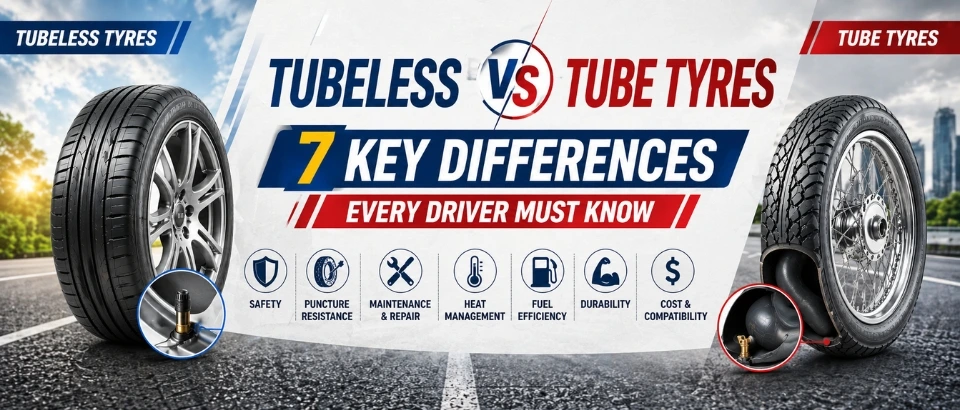
Tyres are a prime part of every vehicle, irrespective of its type or model. It plays a vital role in the vehicle’s safety while running, fuel efficiency, and driving comfort. At present, two types of tyres are available on the market: tubeless tyres and tube tyres. Every vehicle owner needs to know the seven basic differences between these two varieties of tyres so that they can choose the right one for their 2-wheelers or 4-wheelers.
What Are Tubeless And Tube Tyres?
A tubeless tyre does not have a distinct inner tube, which is replaced by an airtight inner lining that can hold air inside the tyre body. A valve is attached to the rim of the tyre to keep the air inside the tyre.
A tube tyre has a separate inner tube that is used for holding air. This tube is placed between the outer tyre body and its rim. If this tube is accidentally punctured, the tyre flattens due to loss of air.
The seven major differences between the tubeless and tube tyre are discussed below, for the convenience of drivers.
1. Construction and design of the tyre
The difference in the structure of a tubeless tyre and a tube tyre is a prime factor that influences the decision of a car owner in buying tyres.
Tubeless tyres:
- No separate inner tube
- Airtight inner lining of the tyre
- A valve attached directly to the rim of the tyre
Tube tyres:
- Composed of a tyre body, a tube, and the rim
- Air pressure is held in this inner tube
- A valve is fixed to the tyre body
Now, most car owners prefer the modern design of the tubeless tyres, which is much simpler and makes the tyres more efficient than the traditional design of the tube tyres.
2. Safety against puncture and air loss
Car owners and drivers are worried about maintaining the air pressure of the tyres while driving their vehicles.
Tubeless tyres:
- If punctured accidentally, air escapes very slowly from the tyre body
- The driver gets enough time to drive the car to a safe parking spot
- The driver can control the vehicle, avoiding accidents
Tube tyres:
- If the tyre is punctured, air escapes from the tyre immediately
- Sudden tyre deflation occurs due to a puncture
- There is a huge risk for the driver to lose control of the car
Therefore, tubeless tyres are much safer for drivers, as only a limited quantity of air escapes through the punctured point of the tyre.
3. Convenience in repairing and maintenance of tyres
The difference in the maintenance of the tubeless and tube tyres is another important factor for choosing tubeless tyres over tube tyres.
Tubeless tyres:
- A puncture repair kit can be used to repair the puncture in the inner lining of the tyre
- Simple plug repair of the puncture of a tyre
- No need to remove the entire tyre for repairing the puncture
- Reduces the time wasted due to tyre punctures
Tube tyres:
- Repairing the punctured tyre is a longer procedure
- The whole tyre has to be removed to repair a puncture
- Needs some professional tools to repair a punctured tyre
Hence, tubeless tyres can be repaired more easily, making it more convenient for drivers during their busy schedules, mainly in urban areas.
4. Generation and management of heat
Heat generation inside the tyre is an important factor that differs between tubeless tyres and tube tyres.
Tubeless tyres:
- Much less heat is generated
- Results in better stability of the tyre
- Easier handling of the vehicle, mainly during long drives
Tube tyres:
- More heat is generated due to the friction between the tyre body and its inner tube
- The efficiency of the vehicle decreases while driving at higher speeds
- The vehicle may wear out more quickly.
Therefore, the tubeless tyres are preferred by drivers who need to drive their vehicles at high speeds for a long time.
5. Fuel efficiency and the weight of the tyre
The weight of the tyres plays a vital role in the fuel consumption of a vehicle. So, the difference in the tyre weight is significant for car owners while selecting the best tyres.
Tubeless tyres:
- Much lighter due to the absence of the inner tube
- Lesser friction within the tyre body
- Better fuel efficiency because of the lighter weight
Tube tyres:
- The inner tube makes the tyre heavier than the tubeless tyre
- More rolling resistance within the tyre body
- Comparatively lower fuel efficiency than the tubeless tyres
Therefore, car owners prefer tubeless tyres over tube tyres to ensure better fuel economy for their vehicles.
6. Durability of the tyre
The period between tyre replacements determines the longevity of that tyre, which differs between tubeless tyres and tube tyres.
Tubeless tyres:
- Offers better resistance to prevent cuts and punctures in the tyres
- Better retention of air
- Remain operational for a longer time
Tube tyres:
- More prone to punctures, which lead to flattening of tyres
- Higher heat generation results in more wear of the tyre
- Lesser longevity of the tyre
Therefore, it is proven that tubeless tyres last much longer than tube tyres, making them the first choice of all car owners.
7. Cost price and compatibility with vehicles
The initial cost of a tyre greatly influences the decision of a car owner when buying tyres for their vehicle.
Tubeless tyres:
- A bit costlier than tube tyres
- Need compatible rims
- More suitable for modern vehicles
Tube tyres:
- Cheaper than tubeless tyres
- Compatible with spoke wheels
- More suitable for bikes and other vehicles of older models
Though tubeless tyres are more expensive, car owners prefer them over tube tyres due to the better efficiency for a longer term.
Conclusion
If a person owns a modern motorbike or car, tubeless tyres will be preferred. In the case of vehicles of older models, tube tyres are quite useful. Also, people prefer tube tyres if they have a budget constraint. People need to consider all the above-mentioned factors while choosing tyres for their vehicles.
For expert guidance and reliable tyre services, you can always trust Swift Tyre Specialist to help you choose the right tyres for your vehicle and ensure a safe and smooth driving experience.