


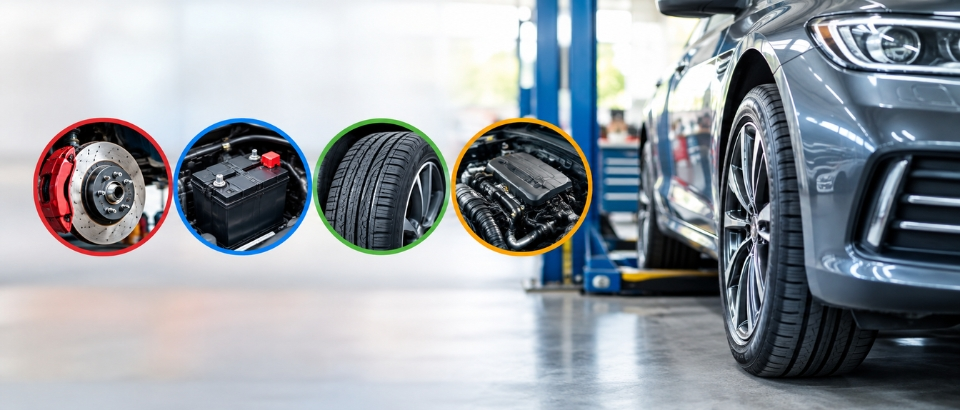
Something on your car is not right. A new noise when you brake. A light that came on this morning. Steering that felt odd on the way home.
The question most drivers ask next is the wrong one. Most people ask how much it will cost. The better question is simpler: can I keep driving this car, or not?
Cost can be sorted out later. Whether the car is safe to drive to work tomorrow cannot. This article gives you a way to sort any brake, tyre, battery or engine symptom into the right level of urgency, so you know what needs attention today and what can genuinely wait.
Four Levels of Urgency
Almost every car problem fits into one of four buckets. Getting the bucket right matters more than knowing the exact fault.
- Stop driving now. The car is unsafe or is actively damaging itself. Pull over somewhere safe and arrange a tow or roadside help.
- Get it looked at today. Still driveable over a short distance, but not something to leave until the weekend.
- Book it this week. Not an emergency, but it will get worse and probably more expensive.
- Mention it at your next service. Worth recording, not worth a special trip.
The rest of this article sorts the four main systems into those buckets.
Brakes Are Almost Always the Most Urgent
Of the four systems here, brakes deserve the least patience. Everything else affects whether the car goes. Brakes affect whether it stops. Braking efficiency of both service and parking brakes is also one of the items checked at an LTA periodic inspection, alongside the wheel system, steering and lights.
Stop Driving Now
- The brake pedal sinks slowly to the floor while you hold it. This usually points to a leak or a failing master cylinder. Pressure that will not hold is pressure you cannot rely on.
- The pedal suddenly feels soft, spongy or travels much further than usual. Air or fluid loss in the system.
- A grinding metal on metal sound when braking. The friction material is gone and metal is cutting into the disc. Every stop from here makes the repair bigger.
- The car pulls hard to one side under braking. One side is doing the work. In an emergency stop that becomes a swerve.
- The brake warning light comes on while driving, particularly with any change in pedal feel.
Get It Looked At Today
- A high pitched squeal when braking that stops when you press harder. Many pads have a small metal wear indicator designed to make exactly this noise. It is a warning, not a failure.
- Vibration through the pedal or steering wheel when braking from speed. Usually warped or unevenly worn discs.
- The handbrake needs far more travel than it used to, or will not hold the car on a slope.
The pattern is that brake noises are warnings and changes in pedal feel are emergencies. A squeal says book something in. A soft pedal says the system is already failing. If you notice either, bring the car to a car repair workshop rather than waiting to see if it clears up. Brake noises very rarely improve on their own.
Tyres Fail Faster Than People Expect
Tyres get less respect than brakes, which is odd, because your brakes can only work as well as the four patches of rubber touching the road.
The National Highway Traffic Safety Administration is blunt about it. Poor tyre maintenance, including not having enough air in your tyres, can lead to a flat, a blowout, or the tread coming off, and 511 people died in tyre related crashes in 2024. Local roads run hot, and heat plus underinflation is the combination that destroys a tyre from the inside.
Stop Driving Now
- A visible bulge or bubble in the sidewall. The internal cords have broken and air is pushing through the weakened area. Not repairable, and it can let go without warning.
- A tyre that keeps going flat within hours of being pumped up.
- Deep cuts, exposed cords or visible fabric anywhere on the tyre.
- Sudden loss of pressure while driving, with the car pulling or the steering going vague.
Any of these means the spare goes on or the car gets towed. The right answer is a tyre replacement, not a plug and a hope.
Get It Looked At Today
- A nail or screw sitting in the tread. Sometimes repairable if it is in the central tread area and the hole is small, but never if it is in the sidewall or shoulder. Do not pull the object out yourself, since it may be the only thing slowing the leak.
- A tyre pressure warning light. Modern systems usually trigger once pressure drops meaningfully below spec, so the tyre is already well down by the time you see it.
- Tread worn down to the wear indicator bars. Bridgestone Singapore notes that LTA legally requires tyres to be replaced when they reach 1.6mm, and that the indicator bars moulded between the tread ribs sit at exactly that depth. If the tread is flush with those bars, the tyre is finished.
We have covered the specific warning signs that a tyre puncture has turned dangerous in more detail separately, including which puncture locations can and cannot be repaired safely.
Book It This Week
Uneven wear across a tyre, a steering wheel sitting off centre, or a persistent pull to one side usually points at alignment rather than the tyre itself. Not dangerous today, but it quietly eats a set of tyres.
Age counts too. Michelin recommends that tyres more than five years old are thoroughly inspected at least once a year by a trained professional, and replaced ten years after their date of manufacture regardless of tread depth or apparent condition.
Battery and Charging Problems Strand You Rather Than Endanger You
Here urgency works differently. A dying battery is unlikely to cause a crash. It is very likely to leave you stuck in a carpark at an inconvenient hour. The urgency is about consequence and timing, not safety.
Get It Looked At Today
- The engine cranks slowly before catching. The classic sign of a battery losing capacity, and in this climate the gap between slow cranking and no cranking is often short.
- You have needed a jump start. One jump start is information, not a fix. A battery that died once will die again.
- Headlights that dim noticeably at idle and brighten when you rev.
- A swollen battery case or a rotten egg smell near the battery. Stop and deal with this one, not for crash risk but because a damaged battery can leak or vent.
A planned car battery replacement costs the same as an emergency one and happens at a far better time.
Battery, Alternator or Starter
These three get confused constantly, and the difference changes what you should do.
- Battery. Struggles to start the car, especially after sitting. Once running, everything is fine.
- Alternator. The car starts on a jump but dies shortly after, or the battery warning light stays on while driving. The alternator recharges the battery as you drive, so when it fails you are running down a battery with nothing putting charge back in. Assume limited range and head straight to a workshop. The fix is an alternator replacement, not another battery.
- Starter. A single loud click or a grinding noise when you turn the key, while the lights and dashboard stay bright and healthy.
A useful shortcut: if the lights are strong but the engine will not turn, suspect the starter. If everything is dim and sluggish, suspect the battery. If it starts and then dies, suspect the alternator. We have gone through the common causes of a car that will not start in more depth if you want the full picture.
Engine Problems Cover the Widest Range
Engine symptoms are the hardest to triage, because the same warning light can mean a loose fuel cap or a failing catalytic converter. What follows is about reading the symptom, not diagnosing the fault.
Stop Driving Now
- The temperature gauge climbing into the red, or a coolant warning. An overheating engine can warp a cylinder head in minutes. Pull over, switch off and let it cool. Do not open the radiator cap while hot.
- The oil pressure light coming on while driving. Not a low oil reminder. It means the engine may not be receiving pressurised oil, and driving on can destroy it.
- A flashing check engine light. Steady means get it checked. Flashing usually indicates a misfire severe enough to damage the catalytic converter.
- Any smoke, or a strong smell of burning or fuel.
- A sudden loud knocking or metallic banging from the engine.
Get It Looked At Today
- The engine stalling at idle or hesitating badly when you accelerate.
- A steady check engine light combined with any noticeable change in how the car drives.
- Visible fluid pooling under the car. Colour helps. Clear water from the air conditioning is normal in this climate. Brown, red, green or oily is not.
Book It This Week
- A steady check engine light with no change in how the car drives. Still get it scanned, since it may be affecting emissions and it will fail an inspection.
- A gradual drop in fuel economy, or a rough idle you can only just notice.
Two Rules Worth Remembering
When two systems complain at once, treat it as urgent. A battery light plus dimming headlights plus a slowing engine is a charging system failing in real time. Individually each is minor. Together they are a countdown.
A symptom that disappears has not necessarily been fixed. Brake squeal that stops, a light that clears itself, a vibration that fades. Intermittent faults are still faults and they return at the worst moment. Note when it happened and what you were doing, then mention it.
The Automobile Association of Singapore puts the principle simply: when you sense something amiss, however major or minor, do not neglect your vehicle.
What Not To Do
- Do not turn the radio up. Obvious when written down, surprisingly common in practice.
- Do not keep topping up a tyre that will not hold air, or a fluid that keeps disappearing. Both mean something is leaking.
- Do not clear a warning light and carry on. Clearing a code does not repair anything. It only removes your early warning.
- Do not assume passing your last LTA inspection means everything is fine. The inspection confirms roadworthiness on the day it was done. It is not a forecast.
Getting a Straight Answer
If you are unsure which bucket your problem falls into, treat it as one level more urgent than you think and get someone to look at it.
At Swift Tyre Specialist we handle tyres, brakes, batteries, alternators, starters and general repairs, and we will tell you plainly whether something needs doing now or can wait. If it needs a specialist we do not have, we will say that too. If the car is not safe to drive to us, we offer onsite and roadside help across Singapore. Call +65 8484 3838 and describe what the car is doing.
Frequently Asked Questions
Q: Can I drive with the brake warning light on?
A: Treat it as a stop, especially if the pedal feels different. The light can indicate low fluid, a system fault, or simply an engaged handbrake. Check the handbrake first. If it is fully released and the light stays on, do not keep driving.
Q: Is a squealing brake noise an emergency?
A: Usually not an immediate one. Many pads have a metal wear indicator designed to squeal when the pad is low. It is a booking, not a tow. Grinding is different, because that means the pad material is gone.
Q: How far can I drive on a spare tyre?
A: Check the sidewall. Space saver spares carry printed speed and distance limits, commonly around 80 km/h, and are meant to get you to a workshop rather than to keep using. A full size spare has fewer restrictions but should still be checked for pressure and age.
Q: My car started after a jump. Do I still need to go to a workshop?
A: Yes. A jump start proves the car can run, not that the problem is solved. If the battery died once it will die again, and if the alternator is the cause the car will stop again shortly. Have both tested.
Q: What does a flashing check engine light mean?
A: A steady light means have it checked soon. A flashing light generally indicates a misfire serious enough to damage the catalytic converter, which is an expensive part. Reduce speed, avoid heavy acceleration and stop driving as soon as it is safe.
Q: Which is more urgent, a brake problem or a battery problem?
A: Brakes, nearly always. A battery failure strands you. A brake failure can cause a crash. If both need attention and you can only do one first, do the brakes.